
The New Bar for Product Managers: The Rise of the Maker
The New Bar for Product Managers: The Rise of the Maker explores how the expectations for great product managers have fundamentally shifted — from slide decks and PRDs to AI tools, side projects, and a maker's instinct to build. The old qualities still matter, but the new bar is simple: are you a maker?
Mark Rose
3/11/20263 min read
There's a version of this essay where I list all the things great product managers do — and that version is still true. Product managers who can build things. Who can talk with customers. Who can understand markets. Who can work with engineers and designers. Who can communicate clearly and ship products that actually matter. These qualities haven't gone away.
But the bar has been raised. And the toolset has changed.
What We Used to Ask For
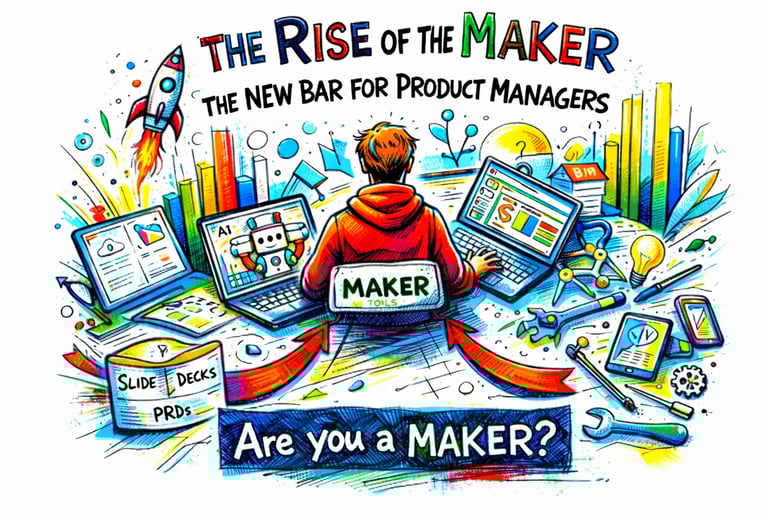
The old toolkit of a product manager looked like this: Google Slides and PowerPoint to tell stories. Google Docs or Notion to write PRDs. The occasional Gantt chart and project plan for the more organized among us.
But here's an honest confession — I never thought the Gantt chart crowd were the great product managers. Those were the tools of project managers. Good project managers, maybe. But let's not confuse the two. That's a category error that's cost a lot of companies a lot of time.
Great product managers were always something different. They were the ones who understood customers deeply, synthesized messy information into clear decisions, and shipped things that mattered. The tools were secondary.
What We're Looking For Now
The new bar for product managers is that they are actively building their own superpowers.
What does that look like in practice? They have multiple AI subscriptions — Claude, Gemini, OpenAI. They pay for all of them, because they're curious about what each one does differently. They use Granola to capture meetings. They use Whisper to transcribe. They use Cursor to write code. They use Claude Code to build and iterate. And more importantly, they're searching — constantly, restlessly — for the next tool that gives them an edge they didn't have before.
This is actually what separates the great ones right now. Not which specific tools they use, but the posture of searching. The curiosity. The willingness to invest in their own capability before their company or boss asks them to.
The Synthesis: Product Builders
Something interesting is happening at the intersection of product management, design, and engineering. The lines are blurring — not disappearing, but blurring.
The new synthesis is product builders. Inventors. Makers.
I've always considered myself a maker. I could concept something, hand-code it, and deploy it to production. Not everyone could do that. And for a long time, that bar was too high for most people to clear without years of engineering experience.
But the barriers to becoming a maker have dropped enormously. What used to require a full engineering background now requires curiosity, some patience, and the willingness to learn with AI as your collaborator.
How to Spot a Maker
When I interview product managers now, I'm looking for makers. Here's how I recognize one:
They have side projects. Not as a resume line item — but because they couldn't help themselves. They had an idea, so they built it.
They build tools for themselves. The maker instinct shows up in small ways: a custom script to save time, a personal dashboard, a bot that does something annoying for them automatically. They don't wait for someone to hand them a productivity solution. They make one.
Their interview deliverables are different. When I give a case study, the makers don't come back with a Google Slides deck. They come back with something interactive. Something that feels like it could actually be a real business. You can tell immediately whether someone engaged with the problem or just performed engagement.
If You're in Product Management Right Now
If you're already in the field: now is the time to show your strength. The makers are going to accelerate past people who are still treating AI as a novelty.
If you're trying to break into product management: the opportunity has never been wider. The artificial gatekeeping that once made it hard to "prove" you could build things is largely gone. You can demonstrate maker instincts without an engineering degree or a decade of experience. You can build something and show it.
The Open Question
I want to be honest about one thing I don't have fully figured out yet.
As product managers build more themselves — as the maker archetype becomes the norm — what happens to the relationship with designers and engineers? What are the new interface lines? Where does the PM's work end and the designer's begin, when the PM can now prototype fairly well? How do engineering teams feel when PMs ship their own tooling?
I don't have clean answers. I think we're all working through it in real time. The healthiest teams I've seen are navigating this with a lot of openness, honest conversation, and mutual respect for what each person brings.
The Mission Hasn't Changed
Here's what I keep coming back to: the goal is still the same.
As product managers — as makers — we're still trying to build things that matter. Products that improve people's lives. That make real differences in how people work, connect, earn, and take care of themselves. That lift the human condition in small and large ways.
The toolset is new. The superpowers are new. But the mission is exactly what it always was.
We just have new tools to get there faster, smarter, and more effectively than ever before. And that, honestly, is exciting.
Mark is Head of Product at Lettuce, a maker, and a coach for product managers navigating the future of the craft.
Copyright 2024. All rights reserved. Privacy Policy. Refunds and Cancelations. Terms and Conditions.