
April 21, 2026 · Mark Rose · 6 min read
Shipping My Own Stack: DNS, Email, AI, and Everything in Between
Owning DNS, hosting, email, forms, and AI tooling shifted my stack from accidental to intentional. Here is what changed, what broke, and why composability beats defaults when you care about control.
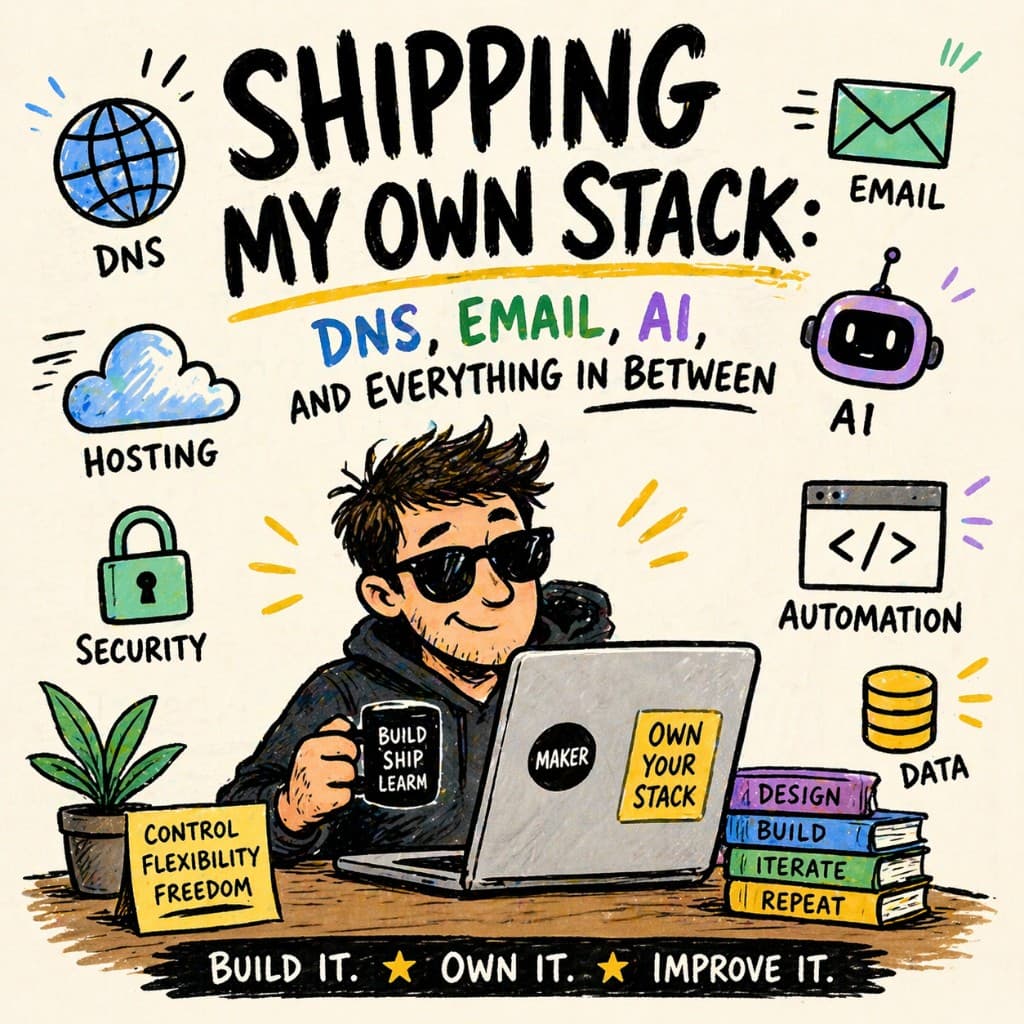
Over the past few weeks, I have been doing something I suspect a lot of product people say they want to do, but rarely follow through on: I have been trying to own my stack.
Not just the product. Not just the roadmap. The actual plumbing: DNS, hosting, email routing, forms, automation, AI tooling, and all the seams in between.
What started as a few small tweaks turned into a surprisingly valuable exercise in understanding how modern software actually fits together.
1. Stop Renting the Basics
Like most people, I had a setup that worked: website hosted on Hostinger, email spread across providers, forms duct-taped together, and subscriptions I did not fully understand.
It was not broken, but it also was not intentional. So the first shift was simple: stop renting everything by default.
- I moved my site to Vercel.
- I moved DNS to Cloudflare.
- I simplified email routing.
Not because those tools are perfect, but because they are composable. You trade a bit of convenience for a lot more control.
2. DNS Is the Control Plane
If you have never really dealt with DNS, it feels like magic until you touch it. Then it clicks: DNS is the control plane for everything.
- Website not loading? DNS.
- Email not arriving? DNS.
- SSL issues? Usually DNS.
Once I moved nameservers to Cloudflare, traffic to Vercel, MX records, and operational control all became explicit and easier to reason about.
3. Email Is Weirdly Hard and Easy
I wanted low-volume email to route to Gmail, the ability to send from my domain, and no heavyweight inbox system.
- Cloudflare Email Routing for receiving.
- Gmail for inbox workflow.
- Resend for sending.
Email is not one system. It is receiving (MX), sending (SMTP/API), and authentication (SPF, DKIM, DMARC). If any of those are off, delivery fails in subtle ways.
The real insight: modern email is less about tools and more about correct configuration.
4. Subscription Drift Is Real
As I audited my stack, I found recurring charges for tools I no longer used: email add-ons, forgotten numbers, and small line items that quietly compounded.
Nothing was huge by itself. Collectively, it was exactly how a stack becomes accidental instead of intentional.
- If you do not know what it does, cancel it.
- If it does not fit the architecture, remove it.
- If it adds complexity, question it.
5. Forms Beat Scheduling Until They Do Not
I initially wanted a form-first flow: users submit context and I follow up manually. Cleaner and more intentional.
But user expectation is clear: people want to pick a time. The practical answer became embedded scheduling, likely Cal.com, styled to feel native.
UX purity loses to familiar mental models more often than product people like to admit.
6. AI Tools Must Fit the Workflow
I have been experimenting with Cursor and AI agents. The tools are powerful, but still require intentional setup: project structure, context management, model choice, and agent boundaries.
The pattern: AI works best when embedded into an existing workflow, not when it tries to become the workflow.
7. Owning the Stack Exposes Tradeoffs
When you own your stack, tradeoffs become visible everywhere: Cloudflare vs simplicity, Vercel vs control, hosted tools vs custom code, automation vs flexibility.
There is no universal best setup. There is only what is appropriate for your stage. For me that means low volume, high control, and minimal overhead.
8. The Real Shift Is Mental
The biggest change is not technical. It is moving from user to builder.
Before, I accepted defaults and worked around limitations. Now, I design the system, choose tradeoffs, and understand failure modes.
That creates a different kind of confidence: not that everything works, but that you can fix it when it does not.
9. If I Started Again Today
- Domain registrar: anywhere.
- DNS: Cloudflare.
- Hosting: Vercel.
- Email receive: Cloudflare.
- Email send: Resend.
- Scheduling: embedded Cal.com.
- Forms: simple API plus email.
Small, composable, understandable.
Final Thought
Most people do not need to build their own stack. But if you are a product person or someone who cares about systems, it is worth trying once.
Not because it is efficient, but because you finally understand how the internet actually works and why things break the way they do.
Share this article
Loading discussion...
Comments
No comments yet. Start the discussion.