
July 5, 2026 · Mark Rose · 12 min read
Product Taste: The Skill That Actually Gets PMs Hired
Frameworks get you in the room. Taste gets you trusted.
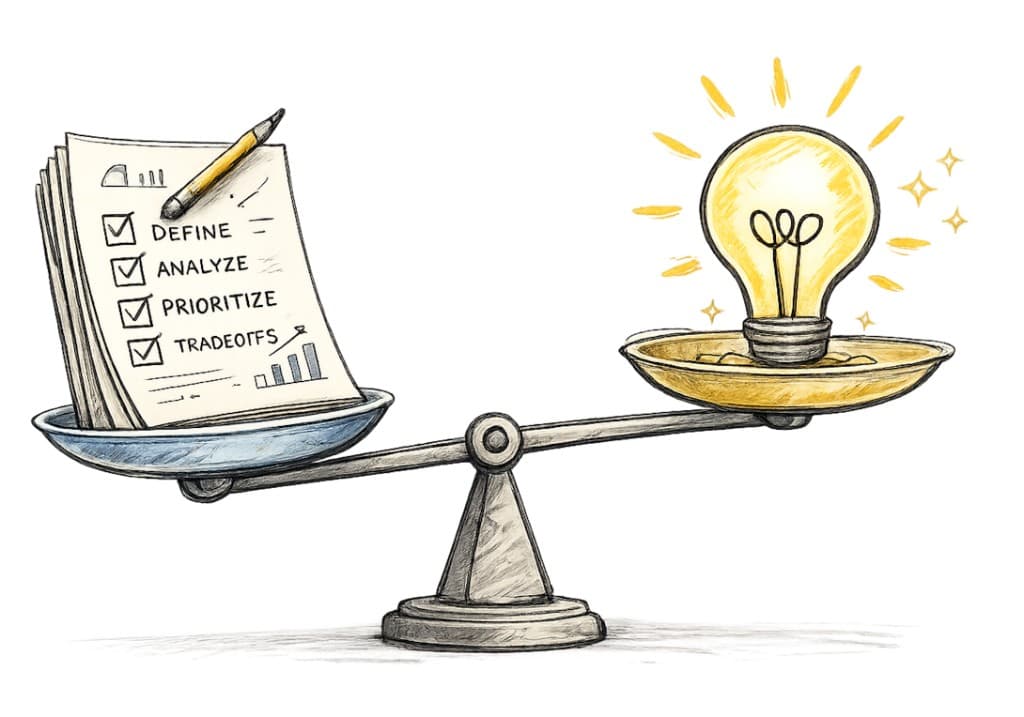
The Rigor Trap
If you learned product management at a place like Google or Facebook, you learned rigor: define the goal, segment the users, prioritize the opportunities, discuss the tradeoffs. Rigor is a wonderful thing. It will get you hired at a lot of companies.
But at taste-driven companies — the Apples, the Airbnbs, the Duolingos — rigor is table stakes, not the test. I coach PM candidates every week, and the pattern is unmistakable: candidates walk in with immaculate frameworks and walk out with rejections, because they answered a question the interviewer never asked. The question the interviewer is actually asking, underneath every prompt, is this: would we trust this person to make our product better?
That's a taste question. And taste is not rigor.
Why Taste Matters Now
"Taste" is having a moment right now, but the lineage is older than the buzzword. Steve Jobs made taste a weapon back in 1996: "The only problem with Microsoft is they just have no taste." Paul Graham argued in his 2002 essay Taste for Makers that taste isn't subjective mush — it's real, it has principles, and it can be developed.
Brian Chesky built Airbnb as an unapologetic designer-founder in exactly that tradition, and spent years being told to run the company more like a spreadsheet before deciding the spreadsheet people were wrong. Chesky on product design at Config 2023 →
Then the AI era detonated the concept. When execution collapses toward zero cost — when anyone can generate the code, the mockup, the deck — the scarce asset is no longer the ability to build. It's the judgment to know what to build and when it's good. Sam Altman started talking about taste as the key human contribution in the age of AI, the New Yorker and half of tech Twitter picked it up, and now taste is the word of the year — complete with a backlash ("taste-washing") from people tired of hearing it. Fast Company on AI and taste →
Here's why this matters for your interview: interviewers feel this shift too. Frameworks are learnable, and increasingly they're automatable. Taste is what they can't teach and can't prompt. So that's what they're probing for — harder than ever.
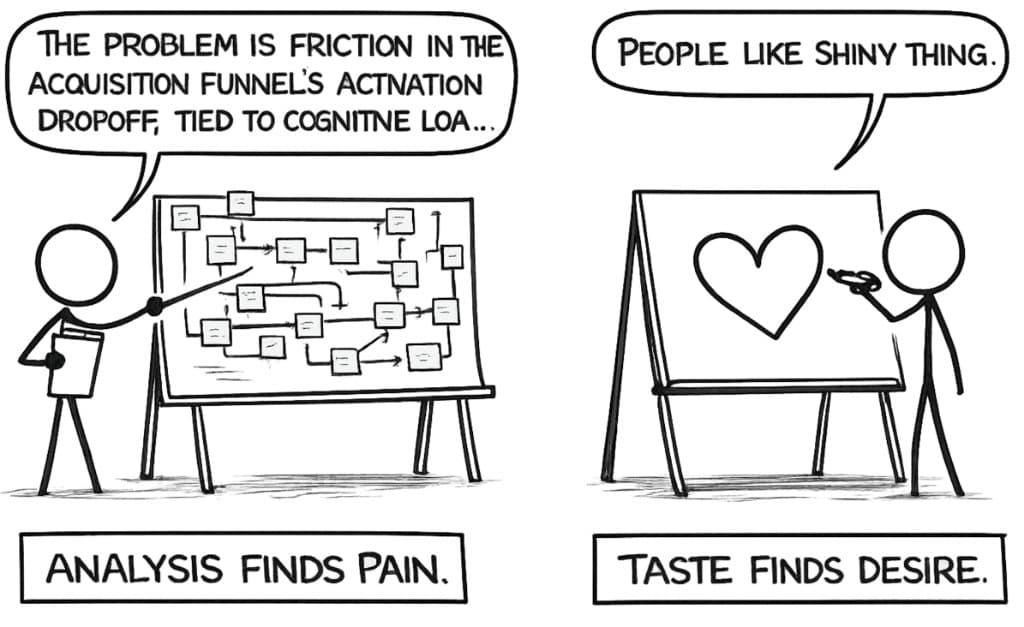
Taste Finds Desire
My favorite way to explain taste is a question I ask candidates: when Apple launched the iPhone in 2007, what phones did people already own?
The answer: products they loved. Blackberry owned the high end — they called it the crackberry. Nokia owned the low end with dense little phones that could survive a nuclear blast. Nobody was complaining. There was no burning pain point. Every analyst said Apple was walking into a disaster.
But look at the lineage of hit phones before the iPhone: the Motorola Razr, the Palm Pilot, the Blackberry. What did they have in common? Every one was a status symbol. Apple read that pattern and built accordingly — not for a pain point, but for a primitive human desire: vanity. Glass and aluminum, visually stunning, unlike anything else. The underlying technologies mostly already existed. The taste was in the emotional insight.
That's the distinction. Solving pain points gives you the 10–40% improvements — good, honest work, do plenty of it. But the 10x products come from desire. Analysis finds pain points. Taste finds desire.
Eight Ways Interviewers Spot Product Taste
Taste sounds abstract, but in an interview it shows up in small, concrete moves. Here are eight I watch for when I'm on the other side of the table.
1. Round like crazy.
When you're estimating, a 3.5 in your rubric is a taste tell — the wrong kind. Say "about 50 million," not "$48.4 million." False precision signals engineer-brain: it proves you've missed the point of the exercise, which is celebrating ambiguity, not eliminating it. I use estimation questions to weed out engineers. The people who are too precise prove to me they have no idea what they're doing. Rubrics should be low/medium/high, and estimates should be round enough to do on a napkin.
2. Treat great decisions as near-ties.
Really good business decisions are close calls — that's why they reached you. Picture the scales of justice: if you do the analysis well, the two options should end up nearly balanced. Taste is showing you genuinely appreciate both sides, then committing anyway: "An intelligent person could go either way here. Based on what I see, this one leans slightly ahead — let's do it." Dogmatic certainty is the opposite of taste.
3. State your conviction level.
Make your humility concrete: "I'm at a 4 out of 10 on this hypothesis. Here's the evidence that would move me to a 7." When the interviewer challenges your estimate, argue against yourself before defending yourself — here's what's pulling it too high, here's what's pulling it too low. Intellectual humility is a taste signal, because taste-driven companies are learning cultures, and you can only learn if you can be wrong out loud.
4. Add "desire" as a rubric column.
When you prioritize opportunities, everyone scores mission, reach, competition, monetization, risk, effort. Almost nobody adds a column for desire: how much do people actually want this? Not how big is the market — how much do they want it? That one column tells the interviewer you understand where 10x products come from.
5. Count the words.
When you critique a screen, information density is measurable. My personal heuristic: if a CTA or label is one to three words, great. Seven words, I'm getting nervous. Twelve to fifteen — danger, warning, eject. If you can articulate a screen's problem that precisely ("this is trying to explain every nuance in copy, and the explanation is itself the cognitive load"), you sound like someone who has looked at ten thousand screens. Because you have.
6. Branch, subtract, and know when to restart.
The great trap of the first idea — human or AI-generated — is that it arrives looking finished, and you fall in love with it. Taste is refusing to iterate on a shape you haven't questioned. Explore three radically different directions before committing to one. When you critique a design, subtract before you add: what would you remove? And when asked what you'd add, the highest-taste answer is sometimes "nothing." Features have to fight their way in — and if the foundation is wrong, don't repaint the house. Extract the intent and reimagine it.
7. Blank sheet, memorized crutch.
Have your frameworks pre-memorized — your rubric categories, your estimation formulas — but always build them live from a blank page. Nothing kills an interview like opening a pre-filled doc and reciting it. And be willing to draw. Most PMs won't sketch, and it's a red flag; a hand drawing shows vulnerability and commitment to the creative process. Here's an old IDEO trick: fold a sheet of paper twice and you get six panels, each about the size of a phone screen. Sketch your flow across them and hold it up to the camera. Senior designers will know exactly who you are.
8. Stay on your floor.
Think of PM skills as a hundred-story tower: strategy in the penthouse, product sense on floors 50–90, execution below, code and wireframes near the ground. Product sense questions live on the taste floors — whiteboard-y, conceptual, curious. Drop into implementation detail mid-answer and the interviewer hears: we don't want you doing the designer's job. We want you to lead the designer.
The Highest Form of Taste
There's one critique layer that sits above all eight tells: mission. Pixels, copy, spacing — these matter, but the highest-taste question in any design discussion is "what are we actually trying to do here?" What emotion should the user feel on this screen? What behavior is it trying to drive? Does it serve the thing the company exists to do?
I had this exact conversation with my own design team recently. We were deep in a debate about copy and components, and I had to stop the room: guys, step back — what are we trying to accomplish? Everyone froze. We'd missed the point.
One guardrail: minimalism is not a religion. You can make things too simple, too — strip out so much that the user is lost. Taste isn't the least density; it's the right density. Which is exactly why it can't be reduced to a rule.
Taste Is a Practice
Here's the good news, and it's the same thing Paul Graham argued twenty-plus years ago: taste is learnable. Not like a framework — like yoga. It's a practice, not a gift, and everyone who shows up on the mat gets better. Taste for Makers →
The practice is simple. Critique one screen a day across three buckets: visual (hierarchy, spacing, clarity), usability (navigation, cognitive load), and value (is this worth building at all?). Ask "what's the desire?" of every product you love — not what pain it solves, but what want it feeds. Count words on CTAs. Sketch by hand. Argue both sides of your own opinions.
Do that for a few months and something shifts: you stop performing taste and start having it. Which matters well beyond the interview — because in a world where execution is nearly free, rigor gets you in the room, but taste is what gets you trusted. Why taste is the ultimate AI-proof skill →
Sources & further reading
- Taste for Makers — Paul Graham (2002)
- Steve Jobs on Microsoft and taste — Wikiquote
- Brian Chesky at Config 2023: 8 Lessons for Product Designers
- Why Tech Bros Are So Worried About AI Having Bad Taste — Fast Company
- The Rise of the Taste Economy — The VC Corner
- "Taste is a new core skill": Silicon Valley's taste conversation in the AI era
- Why Tech Thinkers Say 'Taste' Is the Ultimate AI-Proof Skill — Inc.
Share this article
Loading discussion...
Comments
No comments yet. Start the discussion.