May 19, 2026 · Mark Rose · 7 min read
Time, Not Timing
I didn't plan a career in finance — but twenty years of automatic QQQ deposits for my kids taught me what conviction, compounding, and not selling actually look like.
I didn't grow up thinking I'd work in finance.
I graduated college with a degree in international relations and Russian. The plan was to follow my father into the CIA. That dream never worked out — and it's somehow the best thing that never happened to me.
What did happen: I stumbled into investing. My first job out of school was as a stockbroker. Most people who know me from tech don't know that part. But those early years shaped everything about how I think about money, time, and patience.
I've made a lot of good investments. I've made a lot of terrible ones. And recently, I came across a thesis I should have had all along.
Some lessons take twenty years to figure out.
The best ones are obvious in hindsight.
Time in the market beats timing the market
The first thing I learned — and the thing most people get wrong — was this:
Time in the market beats timing the market.
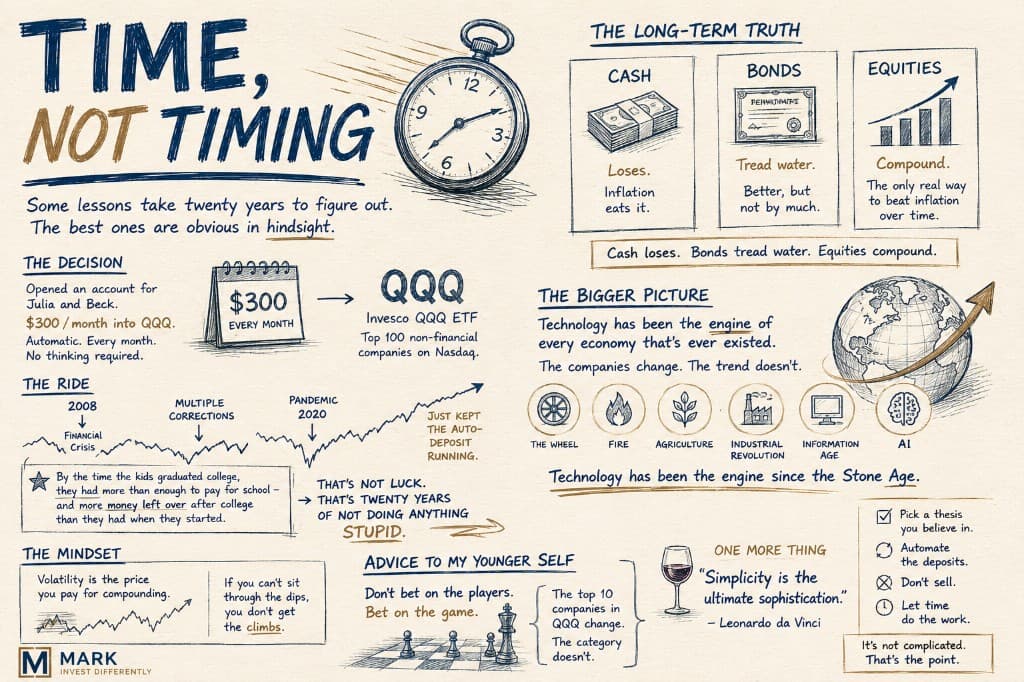
When Julia and Beck were born, I made a small decision. I opened an account for each of them and started putting $300 a month into an ETF called QQQ. Automatic. Every month. No thinking required.
I picked QQQ for a few reasons that felt smart at the time: lower fees than mutual funds, an index structure (lower turnover, fewer capital gains, more of the money stays compounding instead of going to taxes).
Fees are a tax you pay forever.
Capital gains you don't realize keep working for you.
Then I just… didn't touch it.
We lived through 2008. Multiple corrections. A pandemic. I never cashed out. I never sold. I just kept the auto-deposit running.
By the time the kids graduated college, they had more than enough to pay for school — and more money left over after college than they had when they started.
That's not luck. That's twenty years of not doing anything stupid.
The hard part of investing isn't buying.
It's not selling.
Cash, bonds, and equities
Here's the deeper lesson. The one it took me two decades to articulate.
Cash is a terrible long-term investment. Inflation eats it.
Bonds are better, but not by much.
Equities are the only real way to beat inflation over time.
Cash loses. Bonds tread water. Equities compound.
So if you accept that, the question becomes: which equities?
QQQ is essentially the top 100 non-financial companies on the Nasdaq — mostly technology. NVIDIA. Microsoft. Meta. Google. Apple. The names that dominate today's economy. Tech is volatile, but if your time horizon is long enough, volatility stops mattering.
Technology is the engine
A year ago, I heard something that reframed the whole picture for me.
If buying stocks is really buying a piece of the economy — fine, that beats inflation.
But zoom out further, and you see something bigger: technology has been the engine of every economy that's ever existed.
The wheel. Fire. Agriculture. The industrial revolution. The information age. Now AI.
Every major leap in human prosperity has come from technology. Not most of them. All of them.
The companies change. The trend doesn't.
Technology has been the engine since the Stone Age.
When I picked QQQ twenty years ago, I thought I was being smart. Looking back, I was mostly lucky. But the thesis underneath the pick is more durable than the pick itself — and that's what makes it wise now.
Lucky once. Wise twice.
Smart people get to make a wise decision every now and then.
Bet on the game, not the players
Here's what I'd tell my younger self.
Twenty years ago, the top 10 companies in QQQ were almost entirely different than they are today. Twenty years from now, they'll be different again. That's the point. You're not betting on a company. You're betting on the category.
Don't bet on the players. Bet on the game.
The honest part: I wish I'd put more money in.
I had the thesis. I had the patience. I just didn't have the conviction yet. Conviction is what you build by watching the thing work for twenty years and finally trusting it.
Looking forward, I can't think of a better long-term bet than a diversified index of modern technology companies. There will be bubbles. There will be crashes. There will be years that feel terrible.
If your time horizon is long, none of that matters.
Volatility is the price you pay for compounding.
If you can't sit through the dips, you don't get the climbs.
One more thing
If I had to compress everything I've learned about investing into a single sentence, I'd borrow it from Leonardo da Vinci:
Simplicity is the ultimate sophistication.
Pick a thesis you believe in. Automate the deposits. Don't sell. Let time do the work.
It's not complicated.
That's the point.
Share this article
Loading discussion...
Comments
No comments yet. Start the discussion.