
August 3, 2026 · Mark Rose · 10 min read
Pain Points Are Overrated: Why the Best Product Ideas Come from Desires
Pain point thinking drives incremental hits. Desire-based thinking is where the 10x products come from — and nobody complains about a desire in a customer interview.

If you've spent any time in product management, you've been professionally trained to hunt pain points. Find the friction, remove the friction, ship the improvement, collect your performance review. It's the backbone of every product framework, every customer interview guide, every PM interview loop ever conducted.
And look — it works. I coach it. But there's a line I find myself repeating in almost every session, so often that it's basically my catchphrase now:
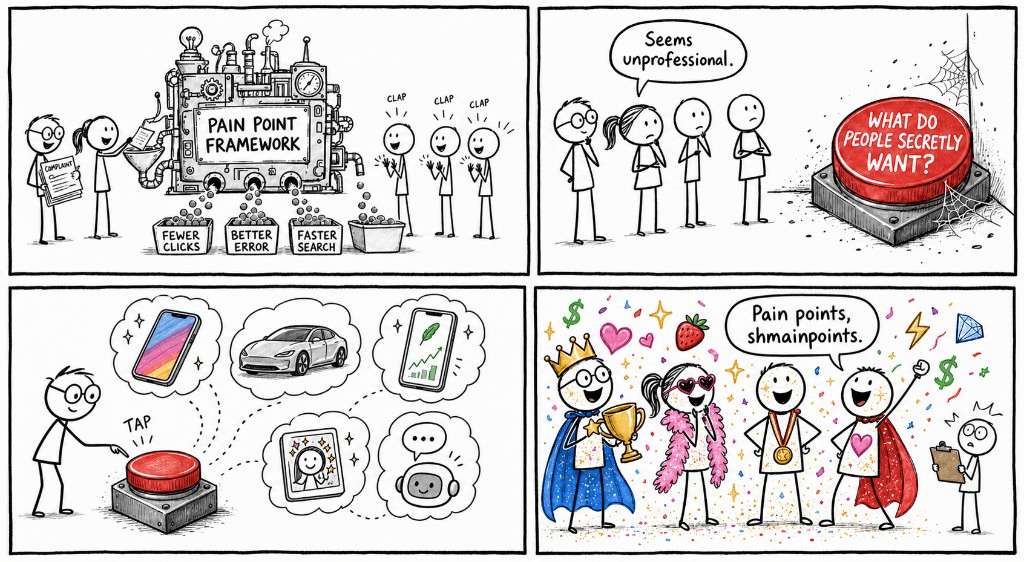
Pain point thinking drives 10, 20, maybe 40% hits. Desire-based thinking is where the 10x hits come from.
Pain points are overrated. Not wrong — overrated. There's a difference, and it's worth about 9.6x.
The two halves of the equation
When I think about why people use (or don't use) a product, there are two parts to the equation. One half is pain points: things that get in the way. The checkout has too many steps. The app is slow. Where's my wallet. Real friction, worth fixing.
The other half is desires: things that, if I could do them, would make my life meaningfully better. And here's the trap — nobody ever complains about the absence of a desire. That's exactly why they're invisible. No customer interview will ever surface "I wish this product made me feel important," because nobody says that out loud. But it's true of nearly everyone in your user base, including you.
Small example. No one has ever filed a support ticket saying "I want a badge." A badge solves nothing. Zero friction removed. But give someone a badge and watch what happens. The desire behind the badge is vanity — the ability to signal, to brag just a little. Tap into that and you've built something people care about far beyond its function. Ask anyone with a Peloton streak.
Nobody was complaining about the BlackBerry
The cleanest illustration I know, and yes, I'm dating myself: think back to 2007, when the iPhone launched. What were people carrying? BlackBerry on the high end, Nokia on the low end. (The Nokia, for the record, could survive a nuclear blast and still make calls. Amazing phone.)
Here's the part everyone forgets: nobody was complaining about the BlackBerry. People loved their BlackBerry. They called it the crackberry. If you'd run a textbook pain point discovery process on smartphone users in 2006, you would not have found a burning platform. You'd have found happy customers, and you'd have shipped a slightly better keyboard.
Apple asked a different question. Not "what's broken about the BlackBerry?" but "why do people carry one at all?" And a big part of the answer was status. You carried a BlackBerry because it made you one of the cool kids. Apple built a beautiful object aimed squarely at that desire — and it was almost instantly successful. A 10x hit, born from desire, while the pain point auditors were still interviewing satisfied crackberry addicts.
Two stories from my coaching sessions
This comes up constantly in the product sense cases I run.
Recently I worked through a Wikipedia case with a candidate: how do you increase donations? The instinct is to catalog the mechanical pain points of donating. But be honest — typing in a credit card number is not hard. It has never been hard. The mechanics are not why people don't donate. It's not a mechanical problem; it's a psychological problem.
The real pain points are psychological, and they're thin: trust ("how do I know my $25 isn't funding three billionaires on a private island somewhere?") and loss aversion ("if I don't give, does this thing go away?"). Fix those and you get incremental lift.
The desires are where the leverage lives. People donate for identity (I'm someone who supports free, human-curated knowledge). For warm glow (giving feels good — that's the actual academic term, by the way). For reciprocity (I've taken value from this thing for twenty years; giving back feels right). For moral urgency (in a world drowning in AI-generated content, an independent, human-built source of knowledge feels worth defending). Wikipedia's banner asks everyone, flatly, please donate. It appeals to no desire whatsoever, which is why you scroll past it. Every time.
A week earlier, a different session: a food-freshness sensor for grocery chains. The candidate did solid pain point work — detect spoilage, catch unripe produce, reduce waste. All good. All incremental. So I pushed: what do grocers desire? Try this: today, every strawberry in the store sells at the same price. What if you could bin strawberries by freshness tier and charge a premium for the freshest ones? "Manager's special" on one end, "picked yesterday" on the other. That's not solving a pain point. That's handing the grocer a superpower — new margin conjured out of thin air — and handing the shopper a way to buy health, freshness, and a little vanity at the same time. Desire on both sides of the transaction. Same sensor.
Products you know that were built on desire
Once you see the pattern, you can't unsee it. Ask yourself what pain point each of these actually solved at launch:
- Instagram. Photo sharing existed. The desire was to look good — to present a curated, flattering version of your life. Filters weren't a feature; they were the whole product.
- Tesla (early years). Cheaper transport? Please. The Model S sold status and identity: I'm wealthy, technical, and virtuous, all in one purchase. Three desires, one car.
- Starbucks. Coffee was already everywhere, and cheaper. Starbucks sold an affordable daily luxury with your name on the cup.
- Nike. Shoes were a solved problem. Nike sells the desire to be an athlete. "Just Do It" is pure aspiration — there is no friction in that sentence.
- Rolex. A $30 quartz watch keeps better time. The entire category exists because of one desire: wealth made visible.
- TikTok. Nobody had a "short video pain point." It taps entertainment, novelty, and — for creators — the shot at being seen.
None of these companies won by finding an underserved complaint. They won by finding an underserved want.
A starter map of human desires
When I coach desire-based thinking, I tell people to start primitive. Human desires are ancient and the list is short. Here's my working map, with the product directions that flow from each:
- Wealth — investing apps, side-hustle platforms, anything promising leverage on money or time.
- Health and vitality — wearables, longevity products, premium-tier "freshest" anything.
- Vanity and status — badges, tiers, checkmarks, luxury goods, anything that helps people signal.
- Belonging and love — communities, dating products, fandoms, multiplayer everything.
- Sex and attraction — grooming, fashion, fitness; the quiet engine behind enormous markets.
- Power and mastery — pro tools, creator platforms, anything that makes someone the expert in the room.
- Freedom and agency — remote work tools, ownership, be-your-own-boss products.
- Knowledge and curiosity — the desire that built Wikipedia in the first place.
For B2B, run the same exercise with business desires: growth, margin, power. The strawberry idea is just a margin desire wearing a sensor.
Testing the thesis: what desire do ChatGPT and Claude tap into?
Here's where I'll speculate a little, because today's AI products might be the best living proof of the whole thesis.
What pain point did ChatGPT solve at launch? You could already search. You could already write. Nobody was petitioning for a chatbot. And yet: fastest-adopted consumer product in memory. That is not pain point economics.
I'd argue ChatGPT and Claude tap two deep desires at once. The first is knowledge — the ancient wish to simply ask and be answered, to have an expert on call for everything. The second is subtler: the desire for effortless capability. Call it the desire to escape drudgery. Or, less charitably, to be productively lazy. Nobody frames it that way in a user interview, but everyone feels it: I want the output without the grind.
Add those together and you get what I call the superpower desire. These products don't fix something broken about you — they extend you. You write faster, think wider, know more. The iPhone didn't fix the BlackBerry, and AI assistants didn't fix search. They tapped a desire so deep most people couldn't have named it. That's exactly where 10x hits live: in the wants nobody says out loud.
Try this next week
Keep your pain point list. It's earning its 20%. But spend real time on the other half of the equation. Three questions to ask about your product:
- What do my customers want, not just what's in their way?
- What would feel like a superpower to them?
- Which primitive desire — wealth, health, status, belonging — is quietly underneath it?
The incremental wins are hiding in the friction. The 10x wins are hiding in the wanting.
Share this article
Loading discussion...
Comments
No comments yet. Start the discussion.