August 28, 2026 · Mark Rose · 8 min read
PQ: I Coined It Mid-Call. A Fox Farm Beat Me to It by Nearly 70 Years.
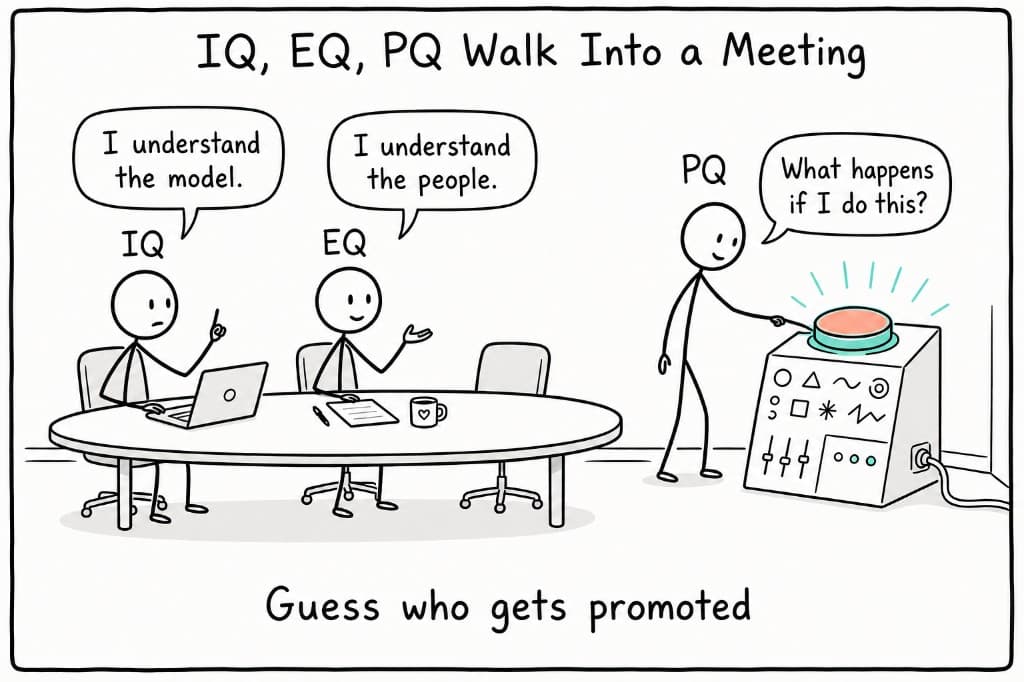
IQ got you in the door. EQ kept you in the room. PQ — plasticity quotient — is whether you let something unfamiliar actually change how you work, or just take good notes.

We were twenty minutes into prepping his pitch to his VP when I said something I hadn't planned to say.
One of my coaching clients — mid-reorg, trying to land a leadership pitch — was mid-riff: something about deployed engineers, PRFAQs, a demo he'd built that walks a room through raw PDFs turning into a working product in real time. Somewhere in there I stopped being his coach and started being a guy having an idea out loud. "It's funny," I said. "I'm going to invent a new term here. I might even write a blog post about it." He didn't even blink. Coaching calls do this to me sometimes.
You know EQ, I told him. Here's a new one: PQ. Plasticity quotient. He lit up immediately, because — of course he did — he'd already built his own version of the same idea, he just never named it. His theory: people forget what it's like to be a kid. Hand a kid a $20 anything and a "why not," and they're building something with it by dinner. Hand a grown adult the exact same tool and watch them wait for a compliance training module to tell them it's okay to touch it.
Here's the thing I actually believe, once the call ended and I sobered up: intelligence isn't the bottleneck anymore, and neither is charm.
PQ — plasticity quotient — is whether you can let something unfamiliar actually change how you work, not just admire it from a safe distance.
IQ got you in the door. EQ kept you in the room. PQ is what happens after — whether you rewire, or whether you just take good notes.
I Didn't Invent This, I Just Said It Out Loud
Turns out I wasn't as original as I felt on that call. Three people got there before me, from three directions that have nothing to do with each other.
Start in Soviet Siberia, 1959, with a geneticist named Dmitri Belyaev breeding silver foxes on a fur farm. He didn't select for cute. He didn't select for smart. He selected for exactly one thing, generation after generation: tameness — which fox would walk up to a stranger instead of running. Within a few generations, without anyone breeding for it, the foxes started showing up with floppy ears, curly tails, and a permanent puppyish streak of curiosity and play they should have outgrown as adults. Select for the willingness to approach the unfamiliar, and a whole cluster of childlike traits comes along for the ride, uninvited. Biologists call it neoteny — staying young on the inside long after the outside has stopped cooperating. Belyaev never used the word "plasticity." He didn't need to. He bred it.
Fast forward a few decades, swap the fur farm for a corporate boardroom. Researchers Michael Lombardo and Robert Eichinger — and later Korn Ferry, who turned it into an entire consulting practice — found that the single best predictor of who gets promoted into ambiguous, unfamiliar territory isn't IQ. It's something they called learning agility: the willingness to walk into a situation you've never seen and actually extract something useful from it. Explicitly, provably, uncorrelated with how smart you are. Some very smart people are terrible at this. Some average ones are exceptional.
Then, more recently, two more names showed up wanting a piece of the EQ conversation. Tomas Chamorro-Premuzic argued in Harvard Business Review that curiosity quotient — CQ — belongs next to EQ as the thing that actually predicts who handles complexity well. A venture capitalist named Natalie Fratto made a similar case for adaptability quotient, arguing the founders worth betting on aren't the smartest in the room, they're the ones who ask the most "what if" questions when the ground moves.
None of these four — a Soviet geneticist, an HR researcher, a psychologist, and a VC — were reading each other's work. They landed on the same trait from four completely different rooms, and each one only got to name their own slice of it.
Curiosity Gets You to Click. Plasticity Gets You to Change.
Here's the part all four of them missed, and it's not their fault — none of them were writing for a world where the unfamiliar thing shows up every month instead of once a career.
Belyaev bred for a trait over generations. Korn Ferry measures it once, in an assessment, then hands you a report. Chamorro-Premuzic and Fratto are both, underneath it, describing a want — the itch to ask "what's in here," to click the thing, to raise your hand in the meeting. That's curiosity, and it matters. It's also not enough. I've coached plenty of people who are plenty curious about AI — they've read the newsletters, they've got opinions about which model is smarter this week — and still haven't changed a single thing about how they actually work. Curiosity got them to open the tab. It didn't get them to close their old workflow.
Plasticity is the part after the click — whether the new thing actually rewires you, or just visits.
That word isn't decoration, by the way. Neuroplasticity is a real, literal property of your brain: the wiring that reorganizes itself with repetition, the pathway that gets stronger the more you actually use it instead of just reading about it. PQ borrows the word honestly, because it's describing the same mechanism at the level of a career instead of a synapse. You don't build it by being curious once. You build it by doing the uncomfortable, slightly embarrassing rep of using the new tool badly, in public, before you're good at it — over and over, until the new way is just the way you work.
That's the piece none of the four had to reckon with. A fox either has the temperament or it doesn't. A leadership candidate takes the learning-agility assessment once every few years. But AI doesn't hand you one unfamiliar situation to prove yourself against — it hands you a new one basically every month. At that pace, wanting to try isn't the differentiator anymore. Almost everyone wants to try, once. What separates people is whether trying sticks.
Exhibit A: The $20 Nobody Spends
The same client from that call, still mid-reorg, said something that's stuck with me all week: "I'm surprised how many people aren't willing to spend twenty dollars a month." Not because they can't afford it — because spending it means admitting, in some small private way, that you don't already know how to do this. Adults hate that feeling so much they'll pay it in avoidance instead of cash. Meanwhile the mandatory AI training everyone's actually forced to sit through is a compliance module with nothing to do with the work — check the box, forget it by lunch, never touch the tool for real.
Contrast that with something I used to ask candidates years ago at Google: you've got $100, how do you decorate your cube? It's a dumb question on paper. No framework answers it correctly. What it actually measured was whether someone would just — start. The candidates who lit up and ran with something specific — a plant, a poster, a ridiculous inside joke only three people would get — were showing me the same trait Belyaev bred into his foxes: comfort walking toward the unfamiliar with no guarantee it'll work out. The candidates who asked "what's the goal of this exercise" were showing me the opposite, and no amount of polish in the rest of the interview made up for it.
Twenty dollars and a plant budget aren't randomly similar examples. They're the same test, run twice, twenty years apart. One measured plasticity before AI made it existential. The other is measuring it right now, in real time, at every company running its own version of this reorg.
Here's the part that should worry any manager watching this play out on their own team: the tool isn't the moat anymore. Everyone has access to the same twenty dollars. The moat is who's willing to spend it.
Try This
You don't need a fox farm or a Korn Ferry assessment to find out where your own PQ sits. Ask yourself, honestly, this week:
- What's the $20 you haven't spent? Name the specific tool, model, or workflow you've been curious about for months and still haven't actually opened. That gap is your PQ, measured in dollars.
- When did you last do something badly, on purpose, in front of people? Not practiced privately until safe — badly, live, where someone could watch you figure it out. If you can't remember, that's the tell.
- If you're hiring or interviewing, what's your version of the cube question? Not "walk me through your resume." Something with no correct answer, where the only thing you're grading is whether the candidate starts.
- If you manage a team, who on it hasn't shipped anything new in the last month — not because they're not smart, but because nothing unfamiliar has actually touched their hands? That's not a talent problem. It's a plasticity problem, and it's fixable in a way an IQ problem never is.
Belyaev never set out to breed curiosity into his foxes. He was just selecting for who'd walk toward him instead of away. Do the same thing to your own week — pick one unfamiliar thing and walk toward it instead of around it — and you'll find out fast whether your PQ is something you have, or something you've just been meaning to get around to.
Sources
Belyaev died in 1985, so Wikipedia is the closest thing to a home page. Lombardo and Eichinger don't have a clean public trail I trust, so the learning-agility work lives on at Korn Ferry. Tomas Chamorro-Premuzic is at his own site; Natalie Fratto's the VC who made the adaptability case — LinkedIn, or the TED talk if you'd rather watch it.
Share this article
Loading discussion...
Comments
No comments yet. Start the discussion.