
August 9, 2026 · Mark Rose · 9 min read
The Professional Product Manager Stack (Or: How I Built a Swim App in 15 Minutes and Nobody Was an Engineer)
In 2026, "I understand AI" is not a superpower. Building something with it — live, in front of another human — is. Here's the free stack I use, and why a live URL beats your resume.
Last week I was coaching a candidate — let's call her R. — through the usual pre-interview gauntlet: how do I pitch myself, how do I get in front of the right leader, how do I stop sounding like a supply chain analyst when I actually want to sound like an e-commerce product leader. Good, normal PM coaching stuff. We did the pitch exercise. We talked about hemispheres of credibility (more on that in a future post). And then she asked me a question that derailed the entire session in the best possible way.
"The leader I'm talking to is big into AI. Anything specific I should bring?"
Here's the thing: in 2026, "I understand AI" is not a superpower. Building something with it, live, in front of another human, is.
So I closed the pitch deck and opened Cursor.
The old flex doesn't work anymore
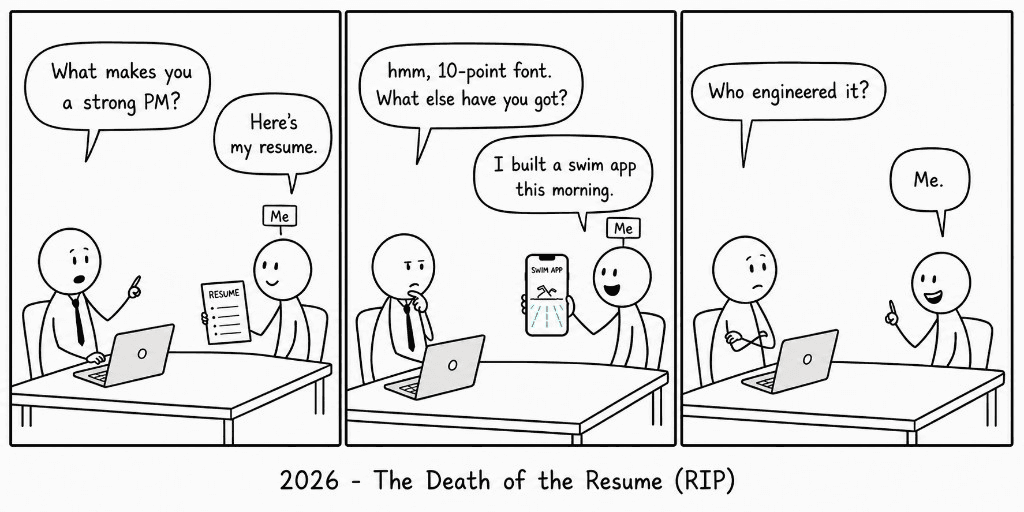
For about fifteen years, the PM flex was the resume. Big brands, big metrics, a tidy walk from analyst to associate PM to PM. That flex still matters — professional street cred gets you in the room. But it doesn't get you the job anymore, because everyone in the room has the resume. What almost nobody in the room has is a live URL they built themselves, this week, for fun.
I told R. this straight: don't just tell them you understand AI. Show them a thing that exists because of you and AI. A shipped, ugly, real thing beats a polished slide about "AI fluency" every single time. It's the difference between saying you can swim and being wet.
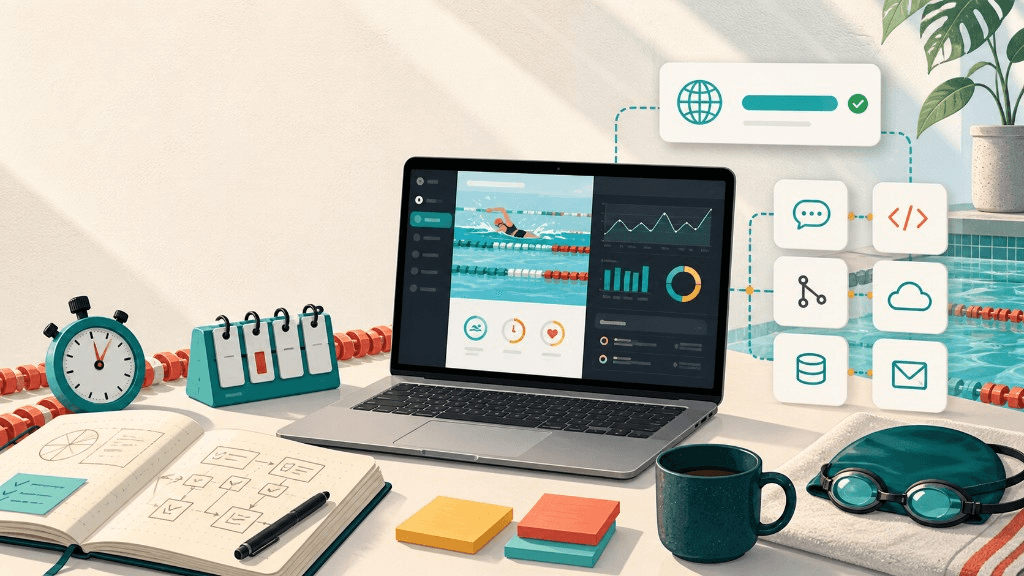
So we built a swim tracker. Because she's a competitive swimmer and I coach masters swimming, and because the best demo project is always the one that's actually about you.
My stack (the whole thing, for free)
I get asked "what tools do you use" a lot, so here it is, unfiltered:
- ChatGPT — for content, spec-writing, and site architecture. This is the ideas machine.
- Cursor — the orchestrator. This is where instructions become code, commits, and deployments.
- GitHub — where the code lives.
- Vercel — serverless hosting. Deploys code and does a great job fast.
- Supabase — great database service.
- Cloudflare — site hosting and email, done right.
A quick aside on that last one, because I earned this opinion the hard way: I also tried Amazon Simple Email Service. It was, somehow, the least simple thing I have ever set up. Sorry, Amazon. Sometimes the truth hurts.
Every single one of these has a free tier. You do not need a subscription to build a real, live, shareable product this afternoon.
Notice what's missing from that list: a computer science degree. An engineering team. Eight weeks of sprint planning. None of it. I haven't hand-written code in two years, and I've shipped more of it than at any point in my career.
Anyone can cook. Anyone can code.
There's a scene in Ratatouille — yes, the rat chef movie, I will die on this hill — where the whole theme collapses into three words: anyone can cook. Not everyone becomes a great chef. But nobody is locked out of the kitchen.
I've had a corollary to that sitting in my head since the movie came out: anyone can code. I used to say it as a nice sentiment. Now I say it as an operating instruction. The barrier used to be syntax. Now the barrier is just knowing what you want and being willing to say it out loud.
Watch what actually happened when I built the swim app with R. on the call. I didn't write a line of code. I talked. I told ChatGPT: I'm a swimmer, I want to log laps by yardage, I want a workout generator based on a pace input, make it feel like Stripe crossed with Duolingo — analytical bones, playful skin. It handed back a spec. I pasted that spec into Cursor and said "build this, push it to a private GitHub repo, stand up a Vercel project." Two or three minutes later, there was a live URL. A hero image. A logo. A favicon, resized into six formats I would never have bothered to make by hand. All from typing in plain English, mostly badly.
That's the actual skill now: the ability to describe what you want clearly enough that a machine can build it, and the judgment to know if what came back is any good. Everything else is plumbing, and the plumbing runs itself.
Why this matters more than your resume
Here's the part everyone forgets when they're prepping for a leadership conversation: leaders aren't hiring your past. They're buying a hypothesis about your future. A decade of e-commerce fulfillment experience tells them what you have done. A live product you built last Tuesday tells them what you're still doing — that you're curious, current, and dangerous with the tools that matter right now.
R.'s original worry was that her current supply chain role would read as un-modern, un-customer-facing, un-exciting. Fair worry! But it evaporates the second you're not asking someone to trust your title — you're handing them a link. Nobody in that interview is going to care whether her day job says "supply chain" or "e-commerce pipeline" once she says, "here, I built this, take a look," and it's real.
Not wrong — overrated. The resume walkthrough is not wrong. It's just overrated. A live artifact does more work in ninety seconds than three paragraphs of bullet points do in three minutes.
Let's get you set up
If you want to try this yourself, the setup is almost insultingly simple:
- GitHub — get this first, everything connects to it eventually.
- Cursor — the desktop app that talks to your files, your GitHub, and your hosting.
- Vercel — connect it to GitHub during setup and forget it exists.
- Supabase — spin this up whenever your project needs to remember things.
- Cloudflare — set it up once and never think about it again.
Upgrade ChatGPT to the paid tier before anything else — the image generation alone is worth the twenty bucks, and it's genuinely better than what Claude or Cursor will give you for graphics. While all of these tools are free, you'll also find that upgrading them gives you a whole new level of superpowers — feature sets, speed, scope, the works. When that upgrade is appropriate for you is purely up to your circumstances and use cases.
One caveat, and I mean this: I'm not dogmatic about this exact lineup. This is what works for me, not scripture. Prefer Claude over ChatGPT? Great. Windsurf instead of Cursor? Fine. Netlify instead of Vercel, Postgres instead of Supabase, Mailgun instead of Cloudflare for email — all fine. DeWalt and Makita both make excellent drills. Nobody cares which one is in your hand. The point is to get drilling.
Try this before your next interview
You don't need a swim app. You need your version of one — something small, personal, and slightly absurd that only you would think to build. A few questions to get you unstuck:
- What's a hobby, habit, or annoyance in your life you've never bothered to build a tool for, because you assumed you'd need an engineer?
- Could you describe that tool, out loud, in three or four sentences, the way you'd explain it to a friend?
- What would the "Stripe meets Duolingo" version of your industry actually look like?
- If a leader asked you "what have you built recently," would your honest answer be a slide deck, or a URL?
Build the thing this weekend. It'll take less time than writing the perfect bullet point about it would have. And when someone asks what makes you good at product management in 2026, you won't need the theater — you'll just have the link.
Share this article
Loading discussion...
Comments
No comments yet. Start the discussion.