
October 26, 2026 · Mark Rose · 6 min read
The Jetsons Got the Button Right
The ski trip that built its own store.
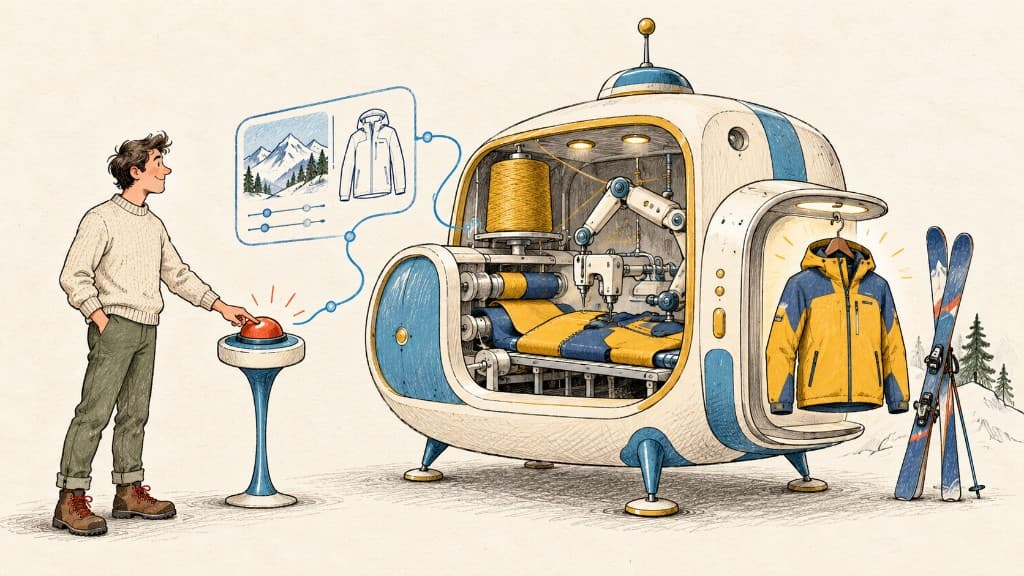
I've been to enough tech conferences to have a finely tuned demo filter. (It mostly produces free socks and a mild headache.) So when OpenAI and Vercel took the stage at Ship this month, I braced for another chatbot that books a flight.
Instead, they showed a high-end boutique that already knew its shopper: their style, their sizes, and the ski trip coming up. The shopper didn't browse a catalog. The site generated a store for them, a ski wardrobe laid out, styled and ready to buy. Not a recommendation carousel. A whole application, assembled on the fly for one person.
My brain produced exactly one reference: it's the Jetsons. (Yes, I'm dating myself. George pushed a button and dinner slid out of the wall. That was the whole bit.)
I kept chewing on it for days. Not on the AI. On what happens when you wire it to a factory.
Push software, meet pull software
Here's the thing. For fifty years we've built software the way Henry Ford built cars. One model, mass-produced, shipped to everyone, hoping it fits. We call it a roadmap, but it's really a push system: we guess what to build, push it out, and watch the dashboards to see who bites.
What I saw at Ship ran the other way. The customer's need pulls the experience into existence, built for them, at the moment they need it.
We're moving from push software to pull software, and the factory is coming along for the ride.
I'm calling the result the App of One: an experience generated for a single customer from what you already know about them, and rebuilt every time their needs change.
"Cool. Who asked for it?"
I described the demo to a colleague a few days later, fully expecting him to share my excitement. He did not. His take: it's a technology looking for a problem. How many people need a bespoke ski wardrobe generated on demand?
He's not wrong. The use case is niche. Most of us don't want a brand-new store every time we shop. We want the "buy again" button.
But I've learned not to judge a technology by its first demo. The first demo is always a toy. The first telephone call was Bell asking his assistant to come into the next room. Nobody saw the group chat coming.
A carmaker, a grocery store, and a very old idea
Pull isn't new. It's very old, and it came from a car company.
Toyota's founders were talking about "just in time" back in the 1930s. After the war, Taiichi Ohno turned it into a system, building out the Toyota Production System through the 1950s and '60s and spreading it to suppliers into the '70s. The rule was simple: make only what's needed, when it's needed, in the amount needed. No warehouses full of guesses.
Fun counter fact. Ohno reportedly took the idea from an American supermarket, a Piggly Wiggly, where shelves were restocked only after customers took something off them. A Japanese carmaker looked at an American grocery store and saw a better factory. Then American carmakers spent the 1980s trying to copy it back.
Software is still in its Ford era. Build the inventory (features), stock the shelves (the release), hope it sells. AI is our Piggly Wiggly moment. When building gets nearly free and nearly instant, you stop guessing. You make it when it's pulled.
The factory is already here (it just isn't wired up)
The demo stopped at the screen. My imagination didn't (my personal product neurosis). If a site can design your ski wardrobe, what stops it from making it?
Less than you'd think. I went looking, and every link in that chain exists today:
- Printing fabric on demand. Kornit Digital makes industrial printers that print straight onto fabric and garments. Printful added more than 50 of them in 2021 alone.
- Design to garment, one at a time. Resonance's CreateOne turns a design into a production-ready garment and only makes it after it sells.
- Yarn straight to pants. Unspun's Vega machine 3D-weaves a pair of pants from yarn in under 10 minutes. No cutting, no sewing. Walmart has piloted it in factories that make chinos.
- Speed. Spreadconnect ships 95% of print-on-demand orders within 48 hours. Shein turns new designs into test batches of 100 to 200 units in 3 to 7 days. (Whatever you think of Shein, and there's plenty to think, the supply chain is real.)
- Patented, kinda? Amazon patented an on-demand apparel factory in 2017: textile printer, cutter, and software that batches orders by delivery address.
Today, "think it, make it, wear it in 48 hours" works for a printed tee. A fully new, cut-and-sewn garment for one person still takes days to weeks, mostly because sewing is still done by hand. The bottleneck isn't the design anymore. It's the needle. But this feels like an automation problem that is solvable.
But wire those links together and the Jetsons button stops looking like a cartoon. It looks like a supply chain diagram. I'd bet on it feeling normal within two years.
Overestimate the demo, underestimate the decade
My skeptical colleague and I eventually landed on the same line: we overestimate the present and underestimate the future. Credit to futurist Roy Amara who said it first: We overestimate a technology's effect in the short run and underestimate it in the long run. Amara's Law has been right about the internet, the smartphone and, so far, AI.
The ski wardrobe is the Model T. Clunky, niche, and the wrong thing to judge the idea by. Judge it by the direction.
When building is free, context is the moat
So what actually changes? The scarce thing moves.
When anyone can generate an app or print a garment, building stops being the hard part. The hard part is knowing who you're building for: their preferences, their situation, what they need next. The boutique demo didn't work because of the model. It worked because the store already knew about the ski trip.
- For PMs: Stop designing one experience for everyone. Design the rules that generate the right experience for each person. Your job shifts from making screens to making the system that makes the screens.
- For founders: Your moat isn't your UI. A UI can be generated. Your moat is the context you've earned about your customer, and how well you connect it to the rest of the chain.
- For both: Personalize to sophistication, not just data.
I see this in my day job. At Lettuce we help solopreneurs run their finances. A savvy S-Corp owner researching the mega backdoor Roth doesn't need the same front door as a realtor who just wants a steady paycheck while her income swings. Same data, completely different product. And honestly? A lot of that doesn't need frontier AI. It needs good rules. AI just makes it cheap enough to actually build.
The front door gets simpler. The product behind it gets personal.
Try this
Pick one product you own this week and ask:
- What do we already know about this customer that the experience ignores?
- If we generated a version of this product for one customer, what would change first?
- What in our chain is still push, built on a guess and stocked on a shelf?
- Where's our needle? What's the one step that keeps us from making it on demand?
The Jetsons got the flying cars wrong. They got the button right.
Sources
- Lean Enterprise Institute: Toyota Production System
- Gemba Academy: Ohno on the origins of "just in time"
- Printful expansion with Kornit
- Resonance CreateOne
- Specialty Fabrics Review: Unspun
- Fast Company: Unspun's Vega
- Shopify: print-on-demand companies 2026
- Sacra: Shein
- Retail Dive: Amazon on-demand apparel patent
Share this article
Loading discussion...
Comments
No comments yet. Start the discussion.