
October 7, 2026 · Mark Rose · 5 min read
When Atoms Go Awry: Why Quality Matters Even More in the Age of AI
A ring, a bot, and a battery that quit early. Quality isn't the absence of failure. It's how well you handle it — and that takes a product that already knows itself.
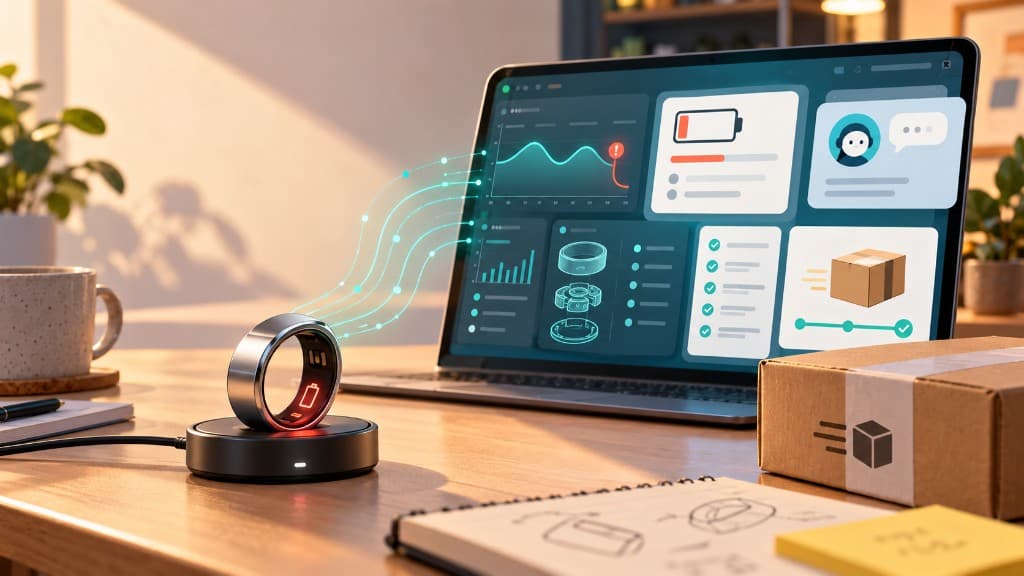
A few weeks ago my Oura Ring started behaving like a flip phone from 2002 (yes, I'm dating myself). I'd charge it, and a day or two later it was dead. This is a ring that's supposed to last five to eight days on a charge. And it was only ten months old.
So I did what any reasonable person does. I grumbled. Then I opened the support chat and braced for the dance: serial number, order number, a photo of the ring sitting on the charger, "have you tried resetting it," and a promise that a human would email me in three to five business days.
Instead, I got this. Their AI agent is named Finn. Here's the whole thread:
Me: My battery life seems poor
Finn: Please do not type for the next few moments while I access your ring's diagnostic information...
Finn: We've discovered an issue with your ring. Let's review your eligibility for a replacement.
Finn: We'll need to ask you a few more questions, which should only take a few minutes.
Finn: If you are eligible for a replacement, we will replace your ring with the same model, color, and size (or the next best option if out of stock).
Finn: Please note: Our support team cannot fulfill requests for a different model or color, and are unable to grant upgrade requests or provide credit for members with previous ring generations.
Finn: Here's the info for the ring we plan on replacing: Size: 14 · Model: Oura Ring 4 · Color: Brushed Silver. Is this the ring we're replacing today?
Me: Yes
Finn: Thanks for confirming! We'll quickly check your order details to make sure we have the correct ring. Please wait a few moments without typing while we review these.
Finn: Do you require a different ring size?
Me: No
Finn: Please confirm your shipping information below.
Finn: Thanks for confirming. Please wait a few moments without typing while we check for available ring replacements. Thank you again for your patience.
Finn: Great news, there's a replacement available for you. The order will be shipped to the address shared in the conversation, and you'll receive a confirmation email from us once it has shipped.
I typed seven words. Seven. Plus one click to confirm my address.
Read that second message again.
While I access your ring's diagnostic information.
The bot reached into a piece of jewelry on my finger, pulled its battery health, decided the hardware was actually bad, and approved a replacement. No human. No photos. No "please describe the issue in more detail." I didn't have to prove anything, because they already knew.
That's not a chatbot. That's a company with an intimate relationship with its own product, wearing a chatbot as a nametag.
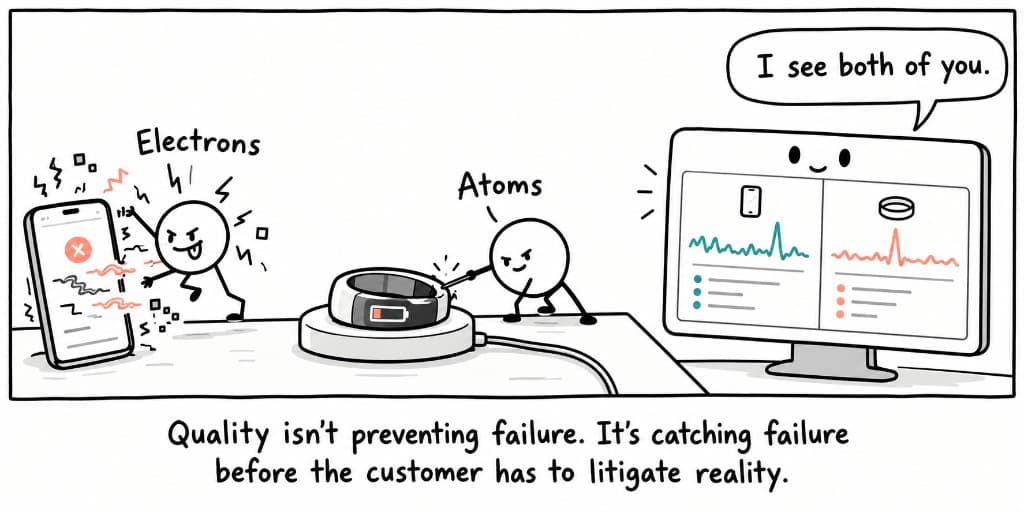
Electrons go awry. Atoms go awry.
If you've been around me or this blog for any length of time, you know quality is woven into my core product management fabric.
Here's the unglamorous part of product management and quality: things break.
In software, things break all the time. Bugs, edge cases, the weird state nobody tested. I call that electrons going awry. Hardware has bugs too, except they're physical. A battery cell degrades early. A solder joint cracks. I call that atoms going awry. Ship enough of anything and both will happen to you. Guaranteed.
So shipping a high-quality product is only the first act. The second act is what happens when it breaks. I call this Second-Act Quality:
Quality isn't the absence of failure. It's how well you handle failure, because failure always shows up.
First-act quality gets you a good review on launch day. Second-act quality gets you loyalty, confidence, and a reputation as a great product company. Nobody writes a love letter about a ring that worked. I'm writing one about a ring that broke.
Support is really two things
When I say support, I mean two very specific capabilities:
- Operability. Can you actually troubleshoot and diagnose the problem? Do you know what's wrong, or are you guessing along with the customer?
- Sustainability. Can you do it at scale, repeatably, without heroics? One great support rep is a nice story. Ten thousand great outcomes a week is a system.
Oura nailed both in about three minutes. Operability: the telemetry told them the battery was bad before I could finish complaining. Sustainability: an agent made a high-confidence decision on its own, with the policy baked right in (same model, same color, no upgrades, no credits). That rulebook isn't a buzzkill. It's what lets the bot say yes without calling a manager.
The AI isn't the hero. The telemetry is.
Here's the thing about "AI customer support": most of it is a very polite way of saying we don't know. A bot without real data is just a faster route to the same dead end.
Finn worked because someone at Oura, probably years ago, decided the ring should report on its own health. Someone instrumented the battery. Someone built the pipeline that lets a support system query a specific device. Someone wrote the replacement policy tight enough that a machine could execute it. The AI is the waiter. The telemetry is the kitchen. And the kitchen was built long before anyone typed "my battery life seems poor."
That's the lesson for anyone building in the age of AI. The agent is the last mile. If you want an agent that makes confident decisions, you need a product that knows itself.
Why this matters more than usual right now
Oura filed publicly in September to list on Nasdaq. The cynical read is that every free replacement ring is a dent in their margins, and I sincerely hope my ring is one of very few.
But I'd argue the opposite. I can't imagine a worse PR moment heading into an IPO than a batch of bad batteries meeting a slow, skeptical support org. Picture the Reddit threads. Picture the photos-of-your-ring-on-the-charger runaround multiplied by thousands. That's not a support problem anymore. That's a brand problem with a stock ticker attached.
Great second-act quality is cheap insurance. A replacement ring costs them a few hundred dollars. A reputation for fighting customers costs a lot more.
Try this
This week, pick the most likely way your product breaks and ask your team:
- If this broke for a customer right now, would we know before they told us?
- What would a support agent (human or AI) need to make a confident decision without asking the customer to prove anything?
- Which decisions could we turn into clear policy, so the front line can just say yes?
- Would this still work at 10x the volume?
If the answers are "no," "a lot," "none," and "definitely not," you have a first-act product and no second act.
Electrons will go awry. Atoms will go awry. Build the product that already knows, and already has the replacement in the mail.
Share this article
Loading discussion...
Comments
No comments yet. Start the discussion.