
July 18, 2026 · Mark Rose · 12 min read
The Age of Concentration: Why a Handful of Companies Now Hold an Almost Surreal Share of Global Wealth
Part 3 of 4 — How Tax Systems Lost Track of Wealth
Roughly ten companies now account for around 40% of the S&P 500. Wealth didn't just migrate into corporations — it piled up into a handful of them, and tax systems still only act when something is sold.

In Part 1, wealth had an address. In Part 2, it packed up and moved into corporations. This is the story of what happened next: it didn't spread out. It piled up.
Part 3 of 4 in the series. If you're catching up: Part 1 — Wealth Had an Address · Part 2 — The Great Migration of Wealth · Part 4 — Can We Tax the Modern Rich?.
In 1086, when King William's scribes set out to catalog the wealth of England, the job took a small army of surveyors, months of travel, and thousands of entries covering every mill, fishery, and pig in the kingdom. The Domesday Book had to be enormous because wealth was everywhere — scattered across the countryside in a million small parcels.
If you wanted to run the same exercise on American wealth today, you could get a shockingly good head start with a list that fits on an index card.
Roughly ten companies now account for around 40% of the value of the S&P 500 — the highest concentration ever recorded, and nearly double the 18–23% that was normal for most of the 1990s and 2000s. Three of them alone represent almost a fifth of the entire index. The Domesday Book needed 900 pages. A meaningful chunk of modern American wealth needs a sticky note.
For five thousand years, the story of wealth was a story of dispersion — thousands of landowners, millions of farms, wealth spread across every valley that could grow wheat. The past few decades ran that story in reverse. This is the part of the series where the numbers stop sounding like economics and start sounding like a misprint.
A Company Walks Into the G7
Here's a sentence that would have gotten you laughed out of any economics department in 1990: a single company that designs computer chips is worth more than the entire annual economic output of Germany.
That's not a hypothetical. In 2026, Nvidia's market value passed $5 trillion — more than the yearly output of Germany, the world's third-largest economy. Only the United States and China produce more in a year than this one company is currently valued at. It is worth more than every economy in Europe. Every single one.
Now, an honest caveat, because this series has tried to earn your trust: GDP and market capitalization measure different things. GDP counts what an economy produces in a year; market cap is a claim on all of a company's future earnings, priced by investor expectations — the great pricing machine we met in Part 2. Comparing them is a bit like comparing a salary to a net worth.
But that's precisely what makes the comparison so revealing. The market has looked at one company and one mid-sized continent's worth of future output and concluded they're in the same league. A medieval tax assessor could survey Germany. Good luck surveying Nvidia.
Why the Winners Kept Winning
None of this happened by accident, and — contrary to the internet's favorite explanations — not primarily by conspiracy either. The concentration is largely a consequence of the economics we traced in Part 2, playing out to their logical conclusion.
Remember the railroad lesson: a network becomes more valuable every time someone joins it. Software companies took that lesson and removed every remaining source of friction. A railroad still had to lay physical track to reach a new city, which involved steel, labor, and the occasional mountain. A software platform reaches its next hundred million users through the internet, at a marginal cost of approximately nothing.
The result is a phenomenon economists politely call "winner-take-most markets." When the product costs nothing to copy, distribution is instant and global, and every new user makes the product more valuable to existing users, there is no natural reason for the second-place company to survive. In farmland, owning the best acre didn't stop your neighbor's acre from producing wheat. In search engines, social networks, and operating systems, it more or less does.
The old economy had gravity. Being big made you slow — more factories, more inventory, more things to break. The new economy inverted it. Being big makes you stronger: more users, more data, more developers, more cash to buy whatever comes next. For most of history, empires got harder to hold as they grew. Software empires get easier.
The Machine That Buys Everything
There's a second force at work, quieter and more mechanical.
Over the past few decades, trillions of dollars of ordinary people's savings moved into index funds — investment vehicles that don't pick stocks at all, but simply buy the whole market in proportion to size. It was one of the great victories for the small investor, and this series has no quarrel with it.
But notice the geometry. An index fund allocates money by market weight. The bigger a company gets, the larger its slice of every new retirement contribution, automatically, forever. Every payday, a river of 401(k) money flows into the market, and the biggest companies stand at the widest part of the river. Concentration isn't just tolerated by the modern financial system; it's built into the plumbing.
The Concentration Inside the Concentration
Here's where the story connects back to taxation, because the concentration doesn't stop at the company level.
Those enormous companies have founders and early shareholders, and their stakes have done something no vineyard ever managed. A person who owns 10% of a $3 trillion company holds $300 billion — a fortune larger than the entire Domesday Book's kingdom, acquired within a single working lifetime, sometimes within a single decade.
Here's the strange part: this wealth isn't hidden. It may be the most visible wealth in history. It's priced to the penny every second the market is open, and the largest stakes are disclosed in public filings anyone can read. The Egyptian surveyor had to wade through Nile mud to value a field. You can value a founder's fortune from your phone, in line at the grocery store.
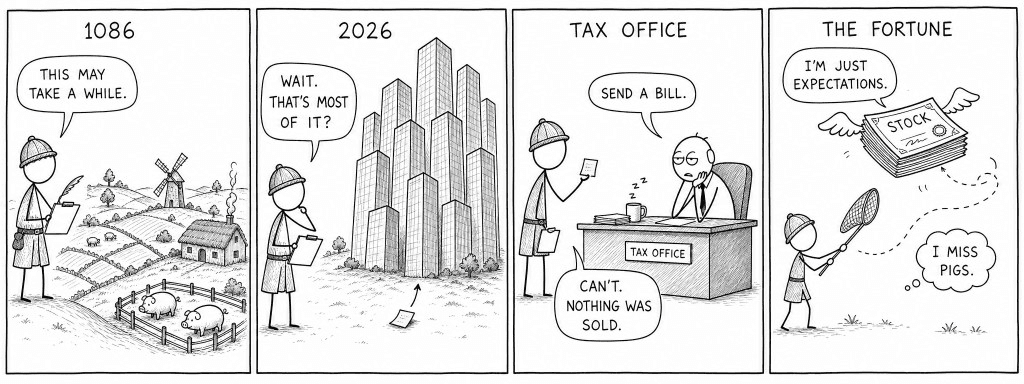
What the tax system lacks isn't sight. It's a trigger. For five thousand years, the assessor could see the wealth and tax it — the field was there, so the tax was owed. Today's system can see the fortune perfectly well, but an unsold share generates no taxable event. Much of it can be borrowed against without ever being sold. So the system watches a $300 billion stake in real time and concludes, year after year, entirely correctly under its own rules: nothing has happened yet.
The Roman census-taker counted the livestock and sent a bill. The modern tax system counts the shares — and waits.
Bigger Than the Kingdoms That Tax Them
Step back and the strangeness comes into focus. Through all of Parts 1 and 2, one assumption held steady: the government was bigger than the wealth it taxed. Pharaoh outweighed any farmer. Rome outweighed any senator. Even the barons at Runnymede, for all their leverage, were negotiating with a king who could — usually — muster a larger army.
That assumption is now wobbling. Several individual companies are worth more than the annual output of the nations trying to tax them. When a corporation's market value exceeds a country's GDP, the negotiation over where profits get booked and which jurisdiction gets paid stops looking like a sovereign dictating terms to a subject. It starts looking like two powers negotiating a treaty — one of which can relocate.
Small countries figured this out early, and some built entire economic strategies around it: offer the lowest rate, attract the paper headquarters, collect a sliver of an enormous pie. The wealth that once couldn't move to a friendlier jurisdiction before the tax collector arrived now does it routinely, electronically, and entirely legally.
The barons needed a civil war to renegotiate with King John. A multinational just needs a good law firm.
The Question We Can No Longer Avoid
So here is where five thousand years of history has deposited us.
Wealth began as land: visible, immobile, taxable. It migrated into corporations: abstract, divisible, mobile. And then it concentrated — into a handful of companies worth more than nations, owned in meaningful part by a handful of people whose fortunes exist mostly as unsold claims on the future — visible to everyone, priced by the minute, and yet largely untouched by tax systems that only act when something is sold.
Which brings us, finally, to the argument everyone wanted to have at the beginning.
Can you actually tax this? Should you? What happens when you try — do the fortunes pay up, or simply float away to friendlier waters? The honest answers are more interesting, and less comfortable for both political camps, than the shouting suggests.
Coming Next
Part 4: Can We Tax the Modern Rich? — The real economic arguments for and against taxing modern wealth, stripped of the politics: what's been tried, what actually happened, and why the oldest problem in taxation is suddenly new again.
Fun fact: I don't just write about the age of concentration — I've quietly benefited from it. Smart investments in QQQ funded my kids' entire college education. The great migration of wealth occasionally migrates in your direction.
Share this article
Loading discussion...
Comments
No comments yet. Start the discussion.