
June 22, 2026 · Mark Rose · 12 min read
Wealth Had an Address: Why Governments Taxed Land for 5,000 Years
Part 1 of 4 — How Tax Systems Lost Track of Wealth
Before we argue about billionaires and wealth taxes, we need to ask what wealth actually is — and why our tax systems still behave as if it has a mailing address.
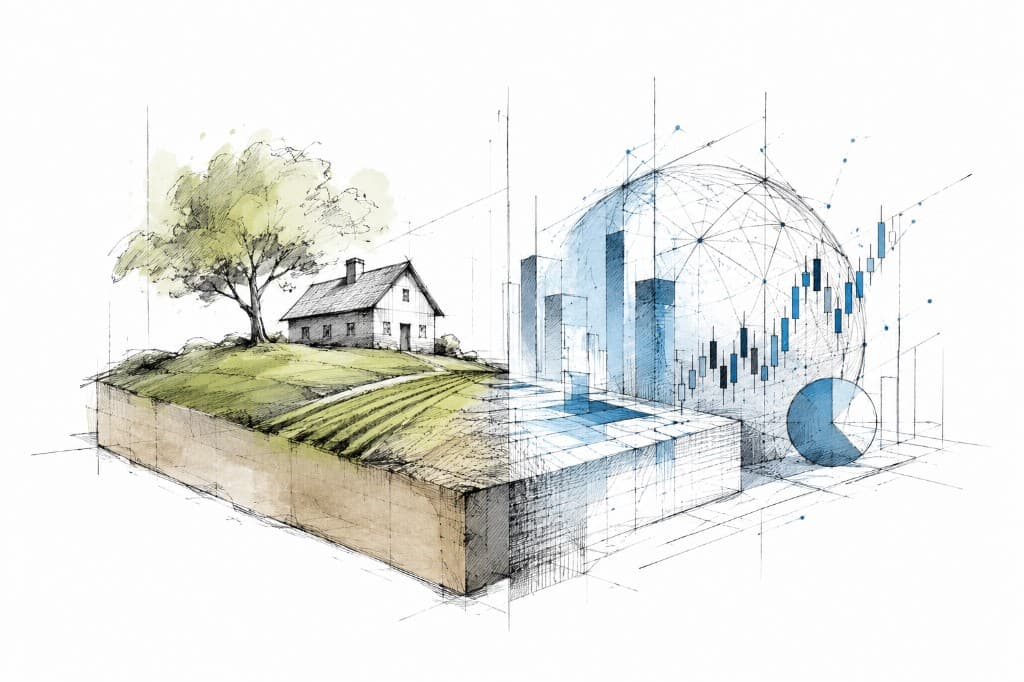
Most debates about wealth taxes start in the wrong place.
People jump immediately to billionaires, stock buybacks, fairness, politics. But before we can argue about how wealth should be taxed, we need to answer a more basic question: what is wealth?
That answer has changed more than most people realize — and our tax systems haven't kept up.
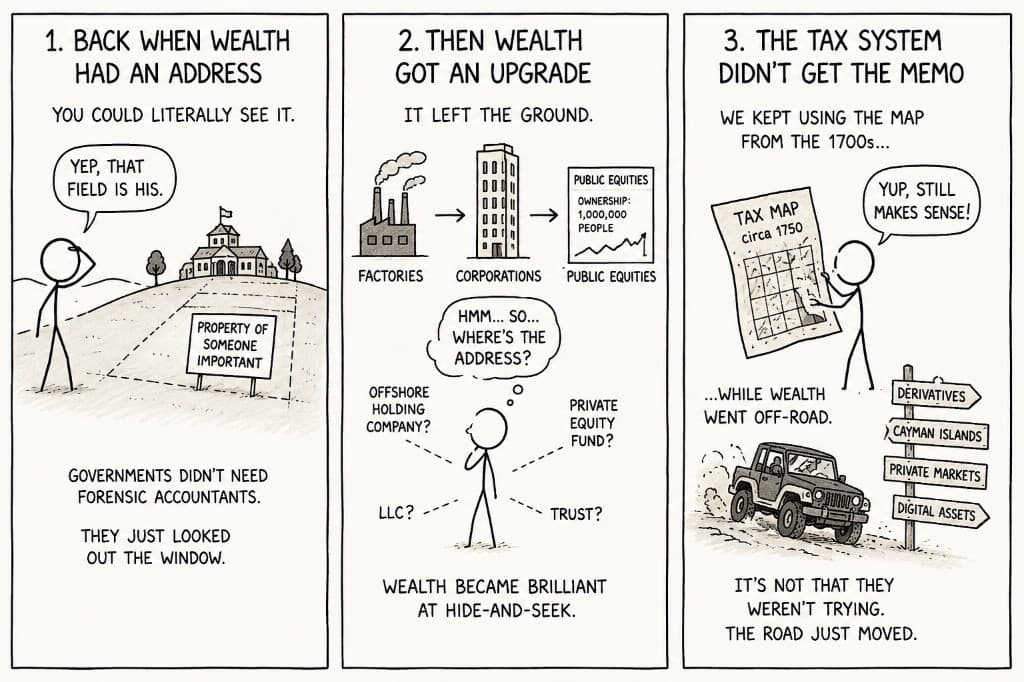
For most of human civilization, wealth was obvious. It had weight. It had coordinates. A farm, a vineyard, a fishing fleet, a warehouse — wealth was something you could walk up to, measure, and argue about with your neighbor. Governments didn't need forensic accountants to find it. They just looked out the window.
Today, the wealthiest person in a room might own more than a medieval kingdom while carrying nothing more than a smartphone and a sense of poorly-disguised smugness. That wealth lives in software companies, equity stakes, and financial instruments that didn't exist a generation ago.
And yet many of our tax systems were built for a world where wealth had a mailing address.
This is the first in a four-part series exploring how wealth changed, how taxation tried to keep up, and why the gap between the two is sitting quietly at the center of almost every serious economic debate today.
The Series
- Part 1: Wealth Had an Address — Why governments taxed land for 5,000 years.
- Part 2: The Great Migration of Wealth — How stocks replaced land as the dominant store of value.
- Part 3: The Age of Concentration — Why a handful of public companies now hold an almost surreal share of global wealth.
- Part 4: Can We Tax the Modern Rich? — The real economic arguments, stripped of the politics.
The Original Wealth Tax
Long before governments taxed income, they taxed property. Partly out of principle, mostly out of necessity.
Think about what it would take to calculate annual income in 500 BC. A farmer grows wheat. Some he eats. Some he trades for a goat. Some rots. Some gets rained on. There are no pay stubs, no bank accounts, no W-2s. There's no spreadsheet. There's barely a number system sophisticated enough to track it.
How much did the farmer earn? Nobody actually knew.
But everyone knew one thing: he owned that field. It was right there. It wasn't going anywhere. And crucially — it couldn't move to a different jurisdiction before the tax collector arrived.
That simple fact shaped taxation for thousands of years.
Ancient Egypt: The First Assessors
Some of the earliest known tax systems emerged in Ancient Egypt, and they were surprisingly sophisticated. Every year, the Nile flooded and deposited rich soil across the farmland. When the waters receded, government officials surveyed the land, estimated agricultural productivity, and assessed taxes accordingly.
These officials were, in a real sense, the world's first property assessors. They maintained records, conducted measurements, and re-surveyed boundaries when the floods shifted the landscape.
The underlying logic is completely recognizable today: the people who control productive land should contribute to the cost of the civilization that protects it.
Rome and the Birth of the Census
The Romans took this further. Regular censuses recorded land ownership, buildings, livestock, and household wealth. The word "census" itself comes from Rome — and it wasn't driven by demographic curiosity. It was a tax instrument.
For the Romans, wealth was tangible. If it existed, it could be counted. If it could be counted, it could be taxed. It's a philosophy so sensible it barely sounds like philosophy at all.
The Domesday Book: The World's First Wealth Database
In 1086, King William I of England commissioned one of the most ambitious administrative projects in history. The result — the Domesday Book — attempted to catalog virtually all taxable wealth in England: landowners, farms, mills, fisheries, livestock, villages, agricultural output. The whole picture.
The question it was designed to answer was refreshingly direct: Who owns what, and how much can we collect?
Modern readers often treat it as a historical curiosity. It wasn't. It was a large-scale wealth database — something like combining a county assessor's office, a land registry, and a tax authority into a single document. The Domesday Book worked because, at the time, wealth and land were nearly synonymous. If you wanted to find the money, you looked at the map.
The Pushback Begins
As governments got better at identifying wealth, property owners got better at resisting. This tension eventually produced one of the most famous documents in history: the Magna Carta.
Popular culture tends to portray the Magna Carta as the birth of democracy. That's a bit generous. It was primarily a negotiated settlement between King John and a group of barons who were tired of having their property seized without warning or limit. Less "dawn of freedom," more "we need some ground rules."
But embedded in that document was a genuinely radical idea: even a king should not have unlimited power to tax and seize property. The history of taxation and the history of political rights are far more entangled than most people realize. Much of what we call "rights" emerged, originally, as arguments about who gets to take whose stuff.
Colonial America and the Property Tax Tradition
The American colonies inherited all of this. Property taxes became the primary source of local government funding — logical, given the same practical advantages that made them attractive for millennia. Land was visible, stable, hard to conceal, and easy to assess.
Income taxes were largely absent because measuring income was still genuinely hard. Even after the United States was founded, the federal government relied primarily on tariffs and excise taxes. The modern federal income tax didn't arrive until 1913 — by which point property taxes had already been a feature of Western governance for centuries.
Why Property Taxes Survived
Economists describe property taxes as unusually efficient — which in economics is a compliment, not a bureaucratic pat on the back. The reason is simple: real estate is extraordinarily difficult to evade. A house cannot move to a friendlier jurisdiction overnight. A parcel of land cannot be transferred to an offshore account before anyone notices. Ownership can be verified. Boundaries can be recorded.
Governments may disagree about almost everything, but they generally know where the land is.
This makes property taxation one of the most durable institutions ever invented. It has outlasted empires, revolutions, and entire economic systems. Very few things have that track record.
The World Changes
The problem is that wealth didn't stay put.
Over the last two centuries, the dominant form of wealth migrated. Railroads became corporations. Factories became corporations. Retail, banking, media, and eventually software — all corporations. And the richest individuals in the world increasingly owned shares rather than land.
Today, a significant share of American wealth exists not in farms or buildings, but in ownership stakes in publicly traded companies — assets that are, by design, highly portable, often opaque, and sometimes valued at numbers that would have seemed like a misprint to any tax official in history.
If tax systems evolved during a period when wealth had a physical address, what happens when wealth becomes mobile, digital, and largely invisible to the naked eye?
That question is where we're going next.
Coming Next
Part 2: The Great Migration of Wealth — How land lost its place at the center of wealth creation, why stocks became the dominant store of value, and what happened when ownership moved from acres to shares.
Part 3: The Age of Concentration — Why a handful of public companies now hold an almost surreal share of global wealth.
Part 4: Can We Tax the Modern Rich? — The real economic arguments for and against taxing modern wealth, stripped of the politics.
Share this article
Loading discussion...
Comments
No comments yet. Start the discussion.