
July 3, 2026 · Mark Rose · 14 min read
The Great Migration of Wealth: How Stocks Replaced Land as the Dominant Store of Value
Part 2 of 4 — How Tax Systems Lost Track of Wealth
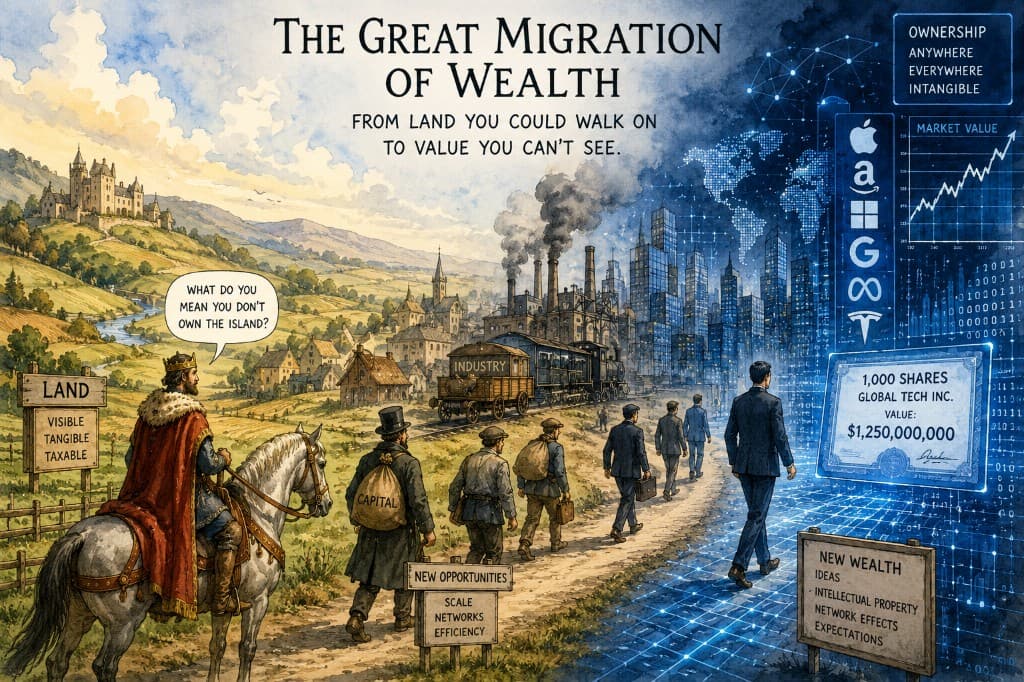
For millennia, land was wealth. Over two centuries, ownership moved from acres to shares — and the tax systems built for immovable property still haven't caught up.
Part 2 of 4 in the series. If you're catching up: Part 1 — Wealth Had an Address · Part 3 — The Age of Concentration · Part 4 — Can We Tax the Modern Rich?.
In Part 1, we saw why governments taxed land for 5,000 years: wealth was visible, immovable, and impossible to hide. This is the story of how wealth packed up and left.
Imagine plucking the world's richest person from the year 1200 and dropping them into the middle of Manhattan.
They'd recognize the buildings — bigger than anything they'd seen, but buildings nonetheless. They'd understand ownership; medieval lords understood ownership better than almost anyone. But if you tried to explain what actually makes people rich in this city, they'd stare at you like you'd lost your mind. Nobody owns the island. The wealth isn't in the towers or the ground beneath them. It's somewhere else entirely — inside corporations, which is to say, inside an idea.
For thousands of years, the equation was almost embarrassingly simple: land equaled wealth. The richest people owned the most productive farmland. Kings fought wars over it, families inherited it, and — as we saw in Part 1 — governments built entire civilizations on the taxing of it. Land produced crops, timber, minerals, rents, and political power. If you wanted more wealth, you wanted more land. This was so obviously true for so long that nobody thought to write it down as a rule. It was just how the world worked.
Then, over roughly two centuries, it stopped being true. This is the story of how that happened — and why the people who collect taxes still haven't entirely absorbed the news.
The First Crack
The Industrial Revolution didn't merely invent factories. It did something subtler and more disruptive: it changed what made land valuable.
Before industry, a field produced wealth because wheat grew there. After industry, that same field might be valuable because someone built a railroad across it, or a mill beside it. The dirt hadn't changed. The source of wealth had quietly moved — from what the land was to what someone had built on top of it.
And the numbers stopped making sense by the old arithmetic. A textile mill occupying two city blocks could generate more income than thousands of acres of farmland. For a landowner in 1820, this was roughly as disorienting as being told your house is worth less than the mailbox. The important asset was no longer the acreage. It was the machine sitting on it.
The Invention That Changed Ownership
Factories introduced a new problem, and it was a problem of scale: they were expensive. Far too expensive for any one family to build, unless that family happened to be extraordinarily rich already.
The solution turned out to be one of the most consequential financial inventions in history — the modern corporation. Instead of one wealthy merchant financing an entire enterprise, hundreds, and eventually millions, of people could each own a small piece of it. Ownership became divisible. The corporation solved a surprisingly human problem: what if nobody here is rich enough to build this alone?
It's worth pausing on what this actually changed. For all of prior history, buying more wealth meant buying more physical stuff — another acre, another vineyard, another ship. Now an investor could buy another share: a claim on an enterprise, rather than a thing you could stand on. Wealth had acquired a new home, and the new home had no coordinates.
Railroads Changed Everything
If you had asked someone in 1850 where the richest people would be a century later, most would have guessed: wherever the most land is. Instead, the great fortunes of the age came out of railroads — and railroads were a preview of everything that came after.
On paper, a railroad looked like a land investment. It owned rights-of-way, stations, terminals, thousands of miles of track. A tax assessor could walk its length. But the real value wasn't the land, and it wasn't even the steel. It was the network. A railroad became more valuable every time another city connected to it, every time another farm shipped grain on it. For perhaps the first time in history, an asset's value depended less on what it physically was than on how many people used it.
That single idea — value living in the connections rather than the property — would eventually produce telephone networks, payment networks, social networks, and the internet. The nineteenth century just got there first, with more coal smoke.
The Rise of the Invisible Company
The twentieth century accelerated all of it. Oil companies, automobile manufacturers, banks, consumer brands, television networks, airlines — decade by decade, wealth accumulated inside corporations rather than directly inside physical things.
A wealthy family no longer needed to own a steel mill, with all the inconvenience that implied. Owning shares of a company that owned dozens of steel mills accomplished nearly the same thing, minus the soot. Ownership had become abstract: a certificate in a filing cabinet could represent factories scattered across three continents.
Today even the certificate is gone. The ownership is an entry in a database. The world's largest fortunes are, in the most literal sense, records — the kind a medieval assessor could not survey, because there is nothing to survey.
Then Software Broke the Equation
If the corporation loosened wealth's grip on the physical world, software let go entirely.
A successful software company can become one of the most valuable enterprises on Earth while owning remarkably little physical property. Its factories are laptops. Its inventory is code. Its distribution system is the internet. Its marginal cost of producing one more copy of its product is, for all practical purposes, zero.
Consider two businesses. One owns 50,000 acres of farmland. The other owns an operating system used by two billion people. Which one is wealthier? For nearly all of human history, the question would have been absurd — of course the land wins. Today it usually doesn't, and it often isn't close.
Wealth Started Floating
By the late twentieth century, wealth had come detached from geography altogether.
A California investor can own shares of a Dutch semiconductor company that manufactures chips in Taiwan that end up in phones sold in Brazil. Where, exactly, is that wealth? The honest answer is that it depends on whether you ask an economist, an accountant, or a tax authority — and they will not agree.
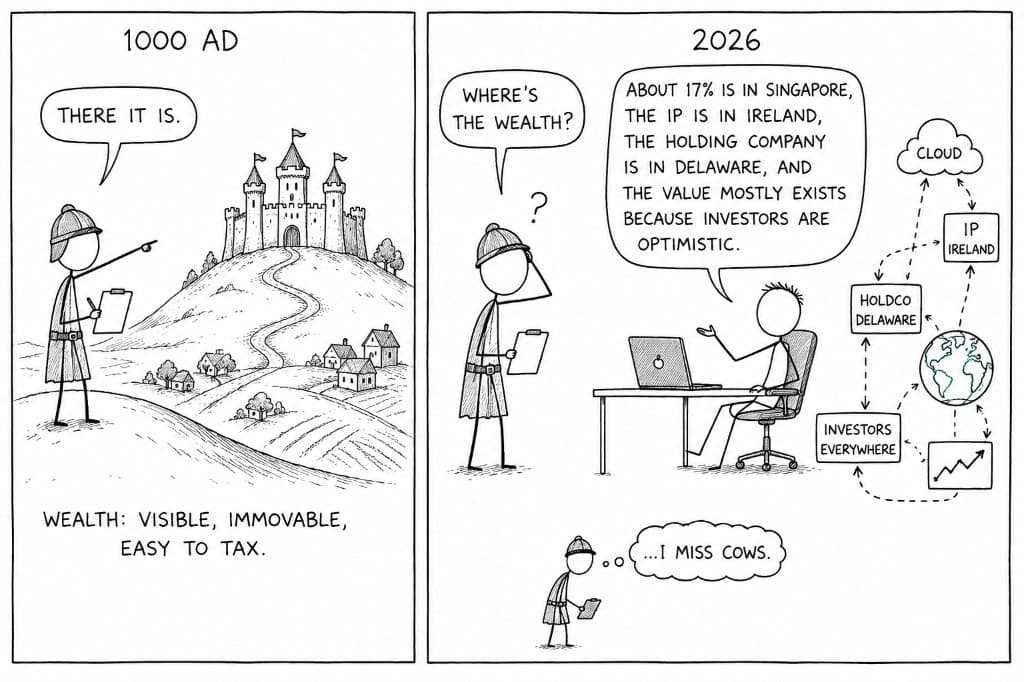
Which is precisely the problem. The tax systems we inherited, the ones descended from Egyptian flood surveys and the Domesday Book, were built for assets that stayed put. Modern wealth exists everywhere and nowhere at the same time, and it can change jurisdictions faster than any tax collector can saddle a horse.
The World's Largest Pricing Machine
One more transformation happened, almost quietly, and it may be the strangest of all: markets stopped valuing possessions and started valuing expectations.
When investors buy a stock, they aren't purchasing today's earnings. They're buying beliefs about tomorrow's. A company's value can rise by hundreds of billions of dollars in an afternoon because investors think something might happen. No new factory appeared. No farmland was discovered. Nothing physical changed anywhere on Earth. Only expectations moved.
Modern wealth, in other words, is built as much from confidence as from concrete. Try explaining that to a Roman census-taker.
A Different Kind of Rich
Compare two billionaires. One owns vineyards, ranches, apartment buildings, and factories. The other owns 8% of a software company. On paper, their net worths are identical. Economically, they are different species. One's wealth can be walked through, fenced, surveyed, and — as five millennia of tax collectors would note approvingly — assessed. The other's exists mostly as claims on future cash flows, priced by the collective mood of global markets.
Our language treats both as "wealth." Our tax systems, for the most part, do too. And that's where the trouble starts.
The Tax Map Didn't Move
The remarkable thing isn't that wealth changed. Economies always evolve. The remarkable thing is how much of our tax architecture still assumes wealth behaves like land.
We still ask the assessor's ancient questions: Where is it? Who owns it? What is it worth today? Those were easy questions when wealth had fences. They're much harder when wealth lives inside multinational corporations, intellectual property, venture funds, cryptocurrencies, and software platforms.
The map stayed the same. The treasure moved.
Coming Next
If wealth migrated from land into corporations, something else happened along the way: it didn't spread out. It concentrated. Over the past few decades, a strikingly small number of companies have come to represent an enormous share of all the wealth ever created — a handful of firms now worth more than the economies of most nations.
Part 3: The Age of Concentration — Why a handful of public companies now hold an almost surreal share of global wealth, and why that changes everything.
Part 4: Can We Tax the Modern Rich? — The real economic arguments for and against taxing modern wealth, stripped of the politics.
Share this article
Loading discussion...
Comments
No comments yet. Start the discussion.