
August 3, 2026 · Mark Rose · 14 min read
Can We Tax the Modern Rich? The Real Economic Arguments, Stripped of the Politics
Part 4 of 4 — How Tax Systems Lost Track of Wealth
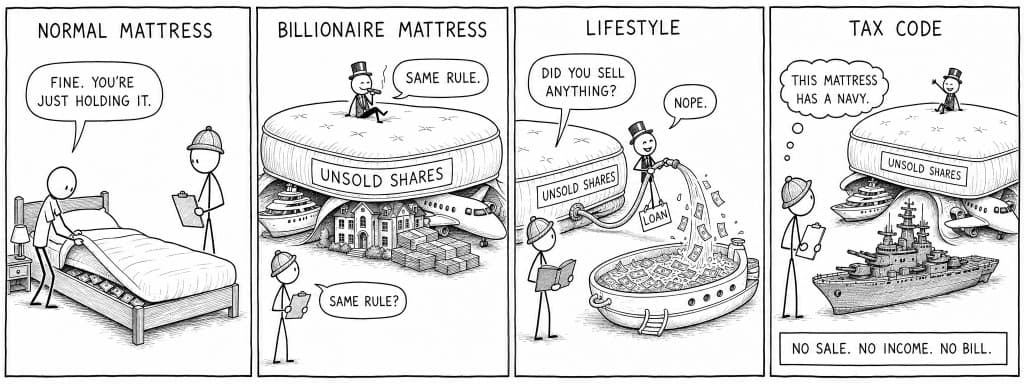
Unsold stock is a fancier mattress — and the load-bearing beam of how large fortunes work. The real debate isn't fairness slogans; it's plumbing: how to tax wealth that can leave.

Part 4 of 4 in the series. If you're catching up: Part 1 — Wealth Had an Address · Part 2 — The Great Migration of Wealth · Part 3 — The Age of Concentration.
In Part 1, wealth had an address. In Part 2, it migrated into corporations. In Part 3, it concentrated into a handful of companies worth more than nations — visible to everyone, priced by the minute, and yet largely untouched by tax systems that only act when something is sold. Which brings us, at last, to the argument everyone wanted to have from the beginning.
Here is the strangest fact in the modern tax code, and once you see it, you can't unsee it.
You can own a piece of a company worth $50 billion, watch it climb to $100 billion, borrow against it, live lavishly off the proceeds, and — as far as the tax system is concerned — earn nothing. No sale, no income, no bill. The wealth is real enough to buy a yacht and imaginary enough to owe nothing. It's the load-bearing beam of how large fortunes work in America, and it follows directly from everything we've traced: when wealth stopped being land and became an unsold claim on the future, the tax system's oldest trigger — you own it, so you owe on it — quietly stopped firing.
The debate about taxing the rich usually opens with fairness, billionaires, and politics. I want to start somewhere less crowded: with the mattress.
The Mattress Test
Let's be fair to the current system, because it's more coherent than the shouting suggests.
If you stuff a million dollars in cash under your mattress, nobody taxes it. Stack gold bars in the basement — same deal. Hold an asset quietly, sell nothing, earn nothing, and the government leaves you alone. There's a real principle there: you're generally taxed when value moves — when you earn it, sell it, or realize it — not merely for possessing it. Unsold stock, in this light, is just a fancier mattress.
So the "we don't tax unsold gains" rule isn't some absurd oversight. It's the mattress principle applied to shares.
The trouble is that the mattress principle isn't applied consistently — not even close. Own a car and you pay registration every year whether you drive it or not. Own a house and the county sends a property tax bill whether or not you ever sell. We already tax plenty of assets simply for existing. We've just carved out a peculiar exception for the single largest category of wealth in the country. The farmer in Part 1 paid tax on land he never sold; the modern shareholder, holding wealth a thousand times greater, pays nothing on stock he never sells. Same principle, opposite outcome — and the difference isn't logic. It's that land couldn't hire a lobbyist.
The Loophole Is Losing Money
It gets better, or worse, depending on where you sit.
Income tax is the part of the system I'd defend without flinching. A business earns revenue, subtracts its costs, and pays tax on what's left. Net income gets taxed. That's fair, that's clean, and I have no quarrel with it.
But notice what that rule quietly rewards. A company can raise millions — even billions — from investors, spend lavishly, grow enormous, and pay little or no tax, because if you never post a profit, there's nothing to tax. Plow every dollar back into growth, and taxable income conveniently vanishes. One of the great tax strategies of the modern era is, put bluntly, don't make money — or spend it all before it can be counted. The company balloons in value, the founder's stake balloons with it, and the tax bill stays roughly zero the entire way up.
The cleanest example is a company you almost certainly bought something from this week: Amazon. For most of its history it ran razor-thin or nonexistent profits on purpose, reinvesting nearly every dollar into warehouses, delivery, and new businesses. The stock climbed relentlessly, Jeff Bezos briefly became the richest person on Earth — and the federal income tax bill stayed close to zero. In 2018, Amazon reported more than $11 billion in U.S. profit and paid $0 in federal income tax; it actually booked a $129 million rebate. The year before: $5.6 billion in profit, also $0. Between reinvestment, R&D credits, carried-forward losses, and stock-based compensation, a company worth hundreds of billions handed the Treasury less than a schoolteacher did. That's the loophole in a single, familiar logo.
This is legal, common, and often genuinely productive — reinvestment builds real things. But let's not pretend it's the same universe the wage earner lives in. The person with a paycheck can't reinvest their salary into themselves and declare a net loss to the IRS.
The Tammy Faye Tell
If you want the purest illustration of the "spend it so it can't be taxed" move, look up from Silicon Valley and over to the megachurch.
We've all seen the images: the private jets, the mansions, the pastor with a watch worth more than the congregation's cars combined — queue every Tammy Faye Bakker meme ever made. Much of that empire runs on a structure where money flows in, gets spent in ways that keep the taxable pile at zero, and the lifestyle materializes anyway. It's a tax dodge dressed in Sunday clothes. The mechanics aren't so different from a perpetually "unprofitable" company that somehow makes its founder a billionaire: keep the visible, taxable number small, and let the wealth accumulate everywhere the number isn't.
I'm not being cynical about faith or about building companies. I'm pointing at the pattern. When the system only taxes what's realized, the winning strategy is to make sure nothing ever technically gets realized.
So Let's Actually Fix It — Carefully
Here's where I part ways with both camps. The left often wants to swing hard enough to feel like justice — less a tax policy than a mob, coming after billionaires with pitchforks and torches, where the point isn't really the revenue collected but the satisfaction of watching the rich squirm. Righteous, cathartic, and a good way to end up collecting nothing from people who can afford a one-way flight. The right, meanwhile, often wants to pretend there's no problem at all — that a $200 billion fortune paying less tax than a plumber is simply the free market breathing, and the rest of us should mind our business. And it's actually weirder than that, because the right doesn't even apply its own principle evenly. It loves some billionaires and despises others, sorted not by how they made their money but by whose team they appear to be on. Elon Musk gets celebrated as a folk hero, a job-creating genius whose wealth is proof the system works. George Soros, worth a fraction as much, gets treated as a shadowy villain whose fortune is proof of a conspiracy. Same tax loopholes, same unrealized-gains magic trick, wildly different verdicts — the difference is politics, not economics. The left, whatever its excesses, at least tends to be consistent: it eyes all billionaires with roughly equal suspicion, Musk and Soros alike. Both camps are wrong, and the interesting answer lives in the uncomfortable middle nobody wants to stand in.
Let's get rid of the dodges. Let's tax large concentrated wealth in a smart, reasonable, boring way — the kind of policy that doesn't make a good protest sign. But — and this is the part the enthusiasts skip — we can't go crazy, because modern wealth has a feature no field ever had: it can leave.
This is the whole lesson of the series come due. Land couldn't flee the tax collector; that's exactly why land got taxed for five thousand years. Modern wealth, as we saw in Part 3, changes jurisdictions with a signature and a wire transfer.
And it isn't hypothetical — it happens at both the personal and the corporate level. In 2021, Tesla moved its headquarters from California to Texas, a state with no personal income tax and a friendlier posture toward exactly the kind of wealth California likes to tax. That's a company voting with its feet across state lines. Now scale it up to the whole country: in 2015, Medtronic — a quintessentially American medical-device giant — legally relocated its headquarters to Ireland by merging with Covidien, in what remains the largest corporate "inversion" in U.S. history. The telling detail is that Medtronic kept thousands of employees and much of its actual operation in Minneapolis. The people stayed. The domicile — the part that matters for tax — flew to Dublin, where the corporate rate was a fraction of America's. The factory couldn't move. The tax address moved with all the drama of a fax machine beeping to life in some office park in New Jersey — no moving trucks, no goodbyes, just a form filed and a rate cut in half.
That's the nightmare version of the design problem. Tax modern wealth too aggressively and you don't collect more — you collect nothing, from a fortune now domiciled somewhere friendlier, even as the buildings and workers stay put. The goal isn't the highest rate. It's the highest rate people will actually stay and pay.
That balance is real, and we have evidence it exists.
The Sun Tax
Consider California. Taxes here are high, sometimes eye-wateringly so, and yet people don't leave in the numbers the simple model predicts. Why? Because they're getting something for it. Locals half-jokingly call it the "sun tax" — the premium you pay to live somewhere the weather is genuinely spectacular.
And look, the weather here is awesome. On a really cold day, I have to put on a sweater. A whole sweater. Life is hard. First-world problems.
The serious point underneath the joke: people and companies will pay more than the theoretically optimal rate when they feel they're getting fair value and reasonable treatment. California proves you can charge a premium and keep your tax base — as long as the deal feels worth it.
Think of it like an iPhone. People spend a genuinely absurd amount of money on a phone, and they do it happily, because they love the product. Try to take it away from an iPhone owner and you'll get a visceral, almost personal reaction. That's a company charging a premium and keeping fierce loyalty — the sun tax in consumer form. But even that loyalty has a price. Charge $2,000 for an iPhone and some devotees start wincing. Charge $5,000 and even the most ardent loyalist's devotion mysteriously evaporates. The love is real, but it isn't infinite, and there's a number where it snaps.
Taxes work exactly the same way. There's a rate people will grumble about and pay, and a rate where the grumbling turns into a moving van. And here's the other side of the California story, the part boosters skip: that ceiling is not theoretical, and we may be brushing up against it. A striking number of tech success stories have already decamped for Texas, Florida, and Nevada for precisely this reason — not because they stopped loving the weather, but because the math finally tipped. And God forbid a new tax aimed squarely at the ultra-wealthy actually passes. The giant sucking sound you'll hear will be money leaving California at record speed — because at that price, it simply pays to leave. Charge $5,000 for the iPhone and even the faithful walk.
That's the entire design problem for taxing modern wealth, in miniature. Not "how high can we push it," but "at what rate does staying still feel reasonable?" Set it there — where the state collects meaningfully and the entrepreneur doesn't feel robbed — and the money stays. Overshoot, and you're left taxing the people who couldn't afford to move, which is precisely backwards.
Where Five Thousand Years Leaves Us
Step back across the whole arc. Wealth began as land: visible, immovable, taxed for millennia because it had nowhere to run. It migrated into corporations: abstract, divisible, mobile. It concentrated into a handful of companies larger than nations. And at every step, our tax architecture — built by Egyptian surveyors and Norman scribes for a world of fields and fences — fell a little further behind the thing it was meant to measure.
The map never moved. The treasure did.
We are not, it turns out, having a fight about greed. We're having a fight about plumbing — about a system that still asks "has value been realized?" in a world where the largest fortunes are specifically engineered never to realize anything. The unsold share is the mattress the county forgot to tax. Fixing it doesn't require a revolution or a guillotine. It requires admitting the old triggers stopped working, and building new ones calibrated to a simple truth the medieval tax collector understood perfectly: you can only collect from wealth that stays put long enough to be counted.
That's the whole game now. Not how hard we tax — but how well we understand what we're taxing.
Thanks for reading all four parts. If nothing else, I hope you'll never look at an "unprofitable" billion-dollar company, or a pastor's private jet, quite the same way again.
The Series
- Part 1: Wealth Had an Address — Why governments taxed land for 5,000 years.
- Part 2: The Great Migration of Wealth — How stocks replaced land as the dominant store of value.
- Part 3: The Age of Concentration — Why a handful of public companies now hold an almost surreal share of global wealth.
- Part 4: Can We Tax the Modern Rich? — The real economic arguments, stripped of the politics.
Fun fact: I've spent four essays arguing that modern wealth compounds quietly inside corporations, untouched, for years. I know this firsthand — smart, patient investing in exactly that kind of asset is what put my kids through college. The system I want to reform is the same one that paid my tuition bills. Make of that what you will; I did.
Share this article
Loading discussion...
Comments
No comments yet. Start the discussion.