
November 2, 2026 · Mark Rose · 14 min read
It's Not a Bubble. It's a Wave.
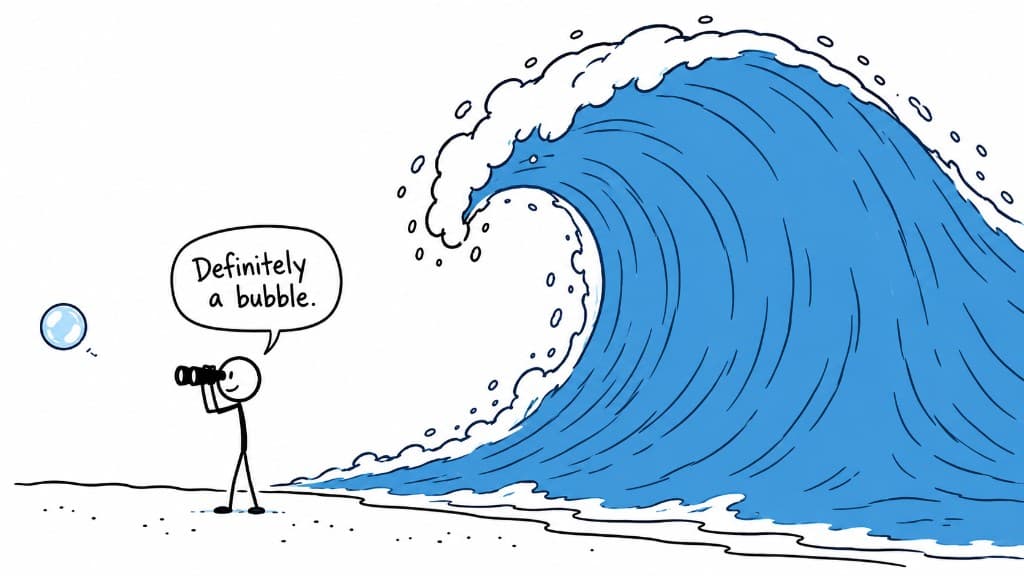
AI isn't a bubble. It's a wave — the biggest one we've ever seen. And the thing that's about to pop is the bubble thesis itself.
Halloween weekend, I did something I'm not proud of. I sat on my couch and photographed my TV with my phone. Eight times. Like it was 1998 and I'd just discovered the disposable camera.
The TV was showing the All-In podcast's breakdown of Anthropic's S-1 ("Anthropic S-1 Shocker, Greatest Business Ever?", Oct 30, 2026). Chamath's team at Social Capital had built slide after slide out of the filing, and every slide made me reach for the phone again. Meanwhile, every other panel on every other channel was asking the same tired question: is AI a bubble?
Here's my take:
AI isn't a bubble. It's a wave — the biggest one we've ever seen. And the thing that's about to pop is the bubble thesis itself.
Bubbles and waves are not the same animal
Most of the bubble debate fails because nobody defines the word. So let's.
A bubble, in the Minsky–Kindleberger sense, is prices running ahead of cash flows. Credit fuels it. It pops when the cash flows never show up to pay the debt. Think of the South Sea Company in 1720: shares rose roughly tenfold on trade that barely existed, then collapsed within months.
A wave, in Carlota Perez's sense, is a technology that resets what the economy can produce. Railroads. Electricity. The internet. Speculation surfs on top of it, and the speculation sometimes crashes. Britain's Railway Mania of the 1840s is the classic case: share prices collapsed in 1847 and wiped out thousands of investors. But the tracks got built, and they carried British growth for a century. The wave doesn't care.
That said, these aren't opposites. The 1840s railway mania and the 2000 dot-com crash were both real waves wearing a bubble on top. The question that matters isn't are prices high? It's are the cash flows arriving — and how fast?
In 1999, the internet had users and no profits. In 2026, AI has customers paying faster than anyone can build the supply to serve them.
Tim Urban told us it would feel boring right before it didn't
In January 2015, Tim Urban published "The AI Revolution: The Road to Superintelligence" on Wait But Why. Yes, I'm citing an 11-year-old blog post with stick figures. Stay with me. Fun personal fact: I started building in machine learning algorithms in 2008 (first using the social graph to predict fraud in payments), so when Tim Urban published in 2015, I thought it was the most brilliant and relevant piece I had read.
Urban's opening thought experiment: bring someone from 1750 to today and the shock might literally kill them. He called it a Die Progress Unit. To get the same shock, that 1750 person would have had to travel back to around 12,000 BC. Each Die Progress Unit is shorter than the last, because progress compounds. Ray Kurzweil calls it the Law of Accelerating Returns.
Then Urban explains why we keep missing it. We extrapolate in straight lines. We judge the future by the last decade. And our own experience makes us, in his words, "stubborn old men about the future."
The killer image: a stick figure standing on an exponential curve. Looking backward, the line looks flat. The steep part is just to the right, where you can't see it yet.
Now put Anthropic's actual quarterly revenue on that curve: $376M, $787M, $1.4B, $2.0B, $4.7B, $11.6B. Five quarters, 31x. Ask someone standing in mid-2025 and it looked like a nice SaaS ramp. Ask someone standing in mid-2026 and the line has gone vertical.
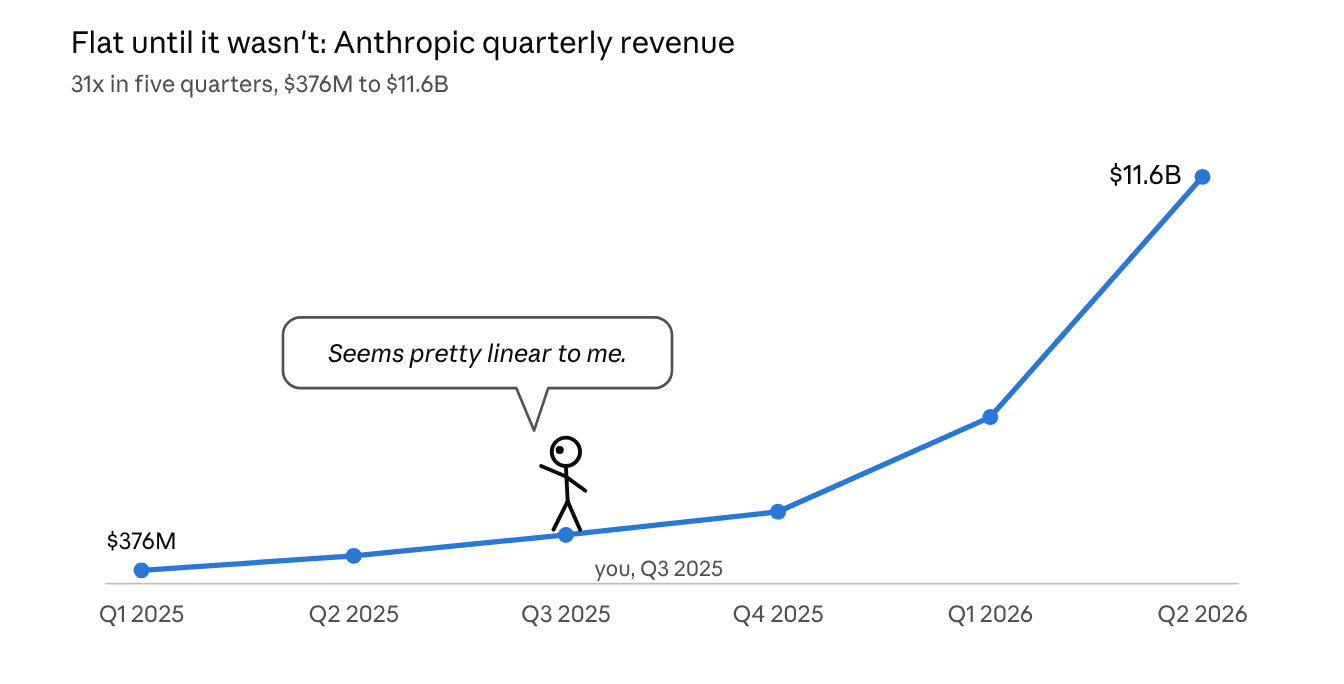
The bubble crowd is the stick figure looking backward. They see a flat-ish line, a lot of debt, and a lot of hype, and conclude the curve can't bend. It already did.
The Wave Test
If bubbles and waves can look alike from the beach, you need a test set that tells them apart.
Test 1: Are the cash flows real?
Bubbles run on promises of revenue later. Anthropic's revenue went from $41 million in 2023 to $386 million in 2024 to $4.6 billion in 2025. Then it booked $16.3 billion in the first half of 2026.
That isn't one big customer, either. Customers paying more than $100K a year went from about 950 to more than 11,900 in twelve months. Net revenue retention is roughly 900%: the average existing customer is spending nine times what it did a year ago.
And here's the line in the S-1 that should scare every bear. Fortune 500 customers' spend with Anthropic averaged under 0.1% of their total expenses in Q3 2026. This is a wave, and it has barely touched the shore.
Test 2: Do the economics improve with scale?
Bubbles get worse as they grow. You need more capital to buy each new dollar of revenue. This is going the other way.
- Gross margin: 39.5% in 2025, 85.4% in the first half of 2026.
- Compute as a share of revenue: 251% in Q1 2025, 48% in Q2 2026.
- Operating income: a $935 million loss in Q1 2025; a $974 million profit in Q2 2026.
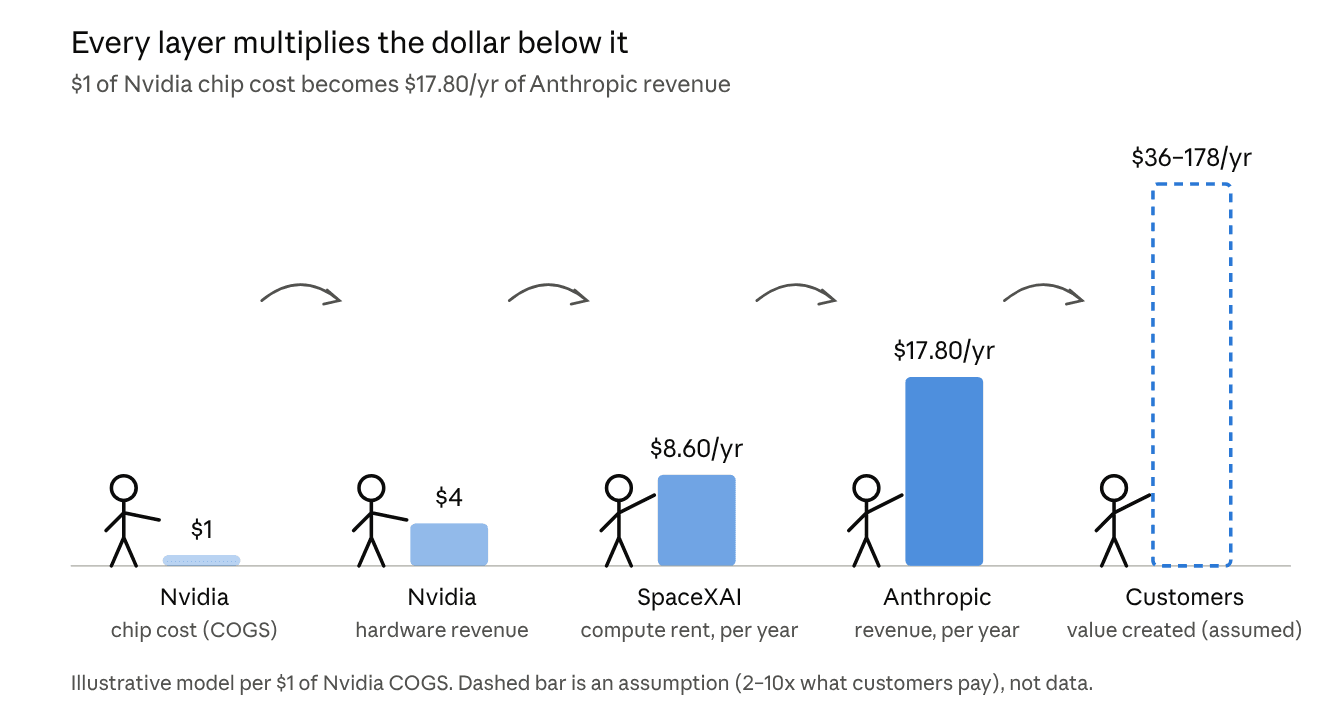
Social Capital's best slide traced where one dollar goes. One dollar of Nvidia's cost of goods becomes $4 of Nvidia revenue, then about $8.60 a year of compute revenue at SpaceXAI, then about $17.80 a year of revenue at Anthropic. Some of those inputs are third-party estimates, and Social Capital says so. But the shape is the point: every layer of this stack multiplies the dollar below it. The economics scale wave is still building.
Test 3: Is supply the bottleneck, or demand?
In a bubble, supply waits for buyers. Think dark fiber in 2002, or empty condos in 2008.
Social Capital ran word counts on the S-1's 88 risk factors. The single biggest topic, at 13.4% of all words, is compute. Inside compute, the biggest theme is data centers. The thing Anthropic is most worried about isn't customers leaving. It's not being able to build fast enough to serve the ones it has.
The money says the same thing. Anthropic has signed roughly $800 billion of compute commitments: Google, Amazon, Microsoft, Broadcom, SpaceXAI, Nscale, Lambda, AMD. SpaceX's S-1 brags that its Colossus II data center brought 220 megawatts online in 64 days, and it's renting capacity to Anthropic at up to $3.1 billion a month. Buyers are waiting for supply. That's a wave.
Test 4: Does productivity show up per worker?
In 1987, Robert Solow quipped that you could see the computer age everywhere but in the productivity statistics. This time it shows up in an audited income statement first. Anthropic generates more than $6.6 million of revenue per employee on a trailing basis with about 5,300 people. Annualize its latest quarter and it's $8.7 million.
For scale, using each company's latest quarter annualized: Nvidia $9.2M, Meta $3.9M, Netflix $3.2M, Alphabet $2.5M, Microsoft $1.7M, SpaceX $0.9M.
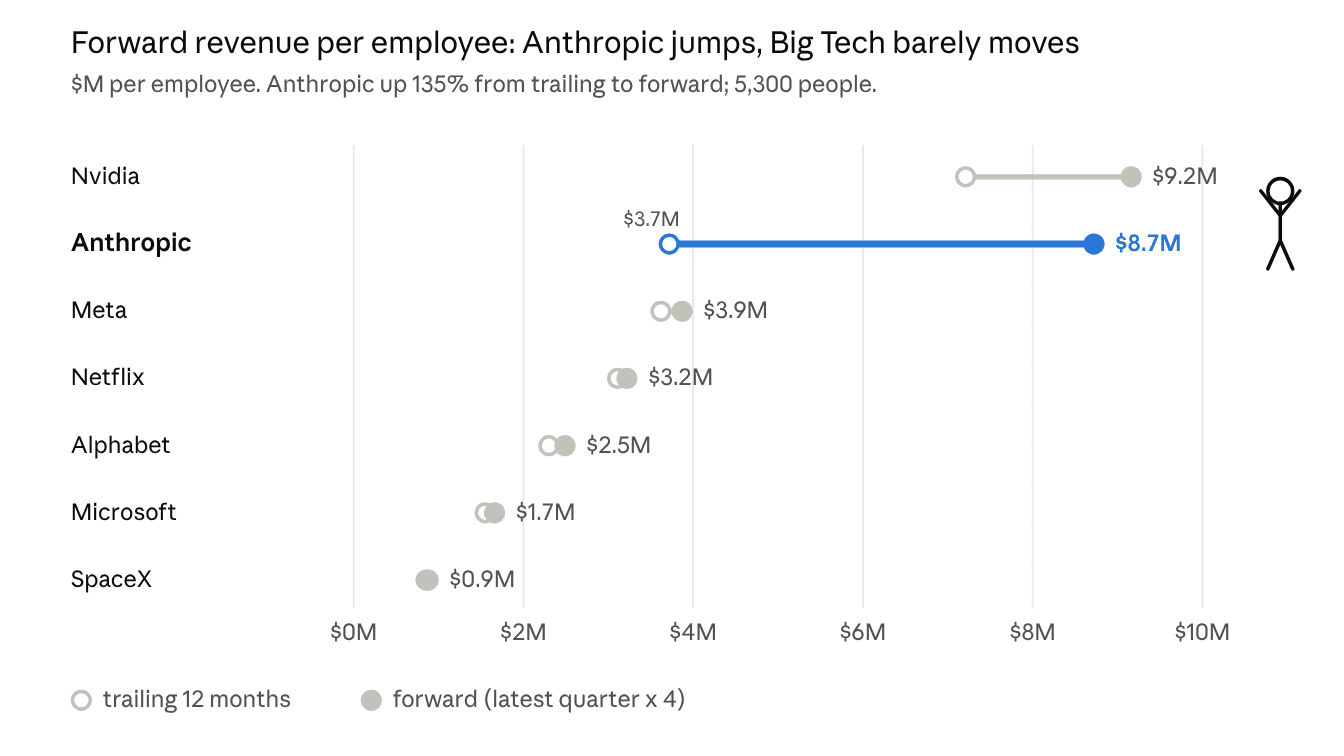
Microsoft is the tell from the other side. Its revenue rose from $198 billion to $332 billion over four fiscal years. Its headcount went from 221,000 to 223,000. AI isn't just a product these companies sell. It's already changing how many humans it takes to run them.
Four tests. Four for four. Waves pass this test. Bubbles don't.
The loop is closing
The wave test says the cash flows are real. This section explains why the curve keeps bending upward. It's also where Tim Urban stops sounding like science fiction.
Urban's big 2015 claim was about what happens when AI starts improving AI. Each generation helps build the next. Progress stops adding and starts multiplying. He called it an intelligence explosion.
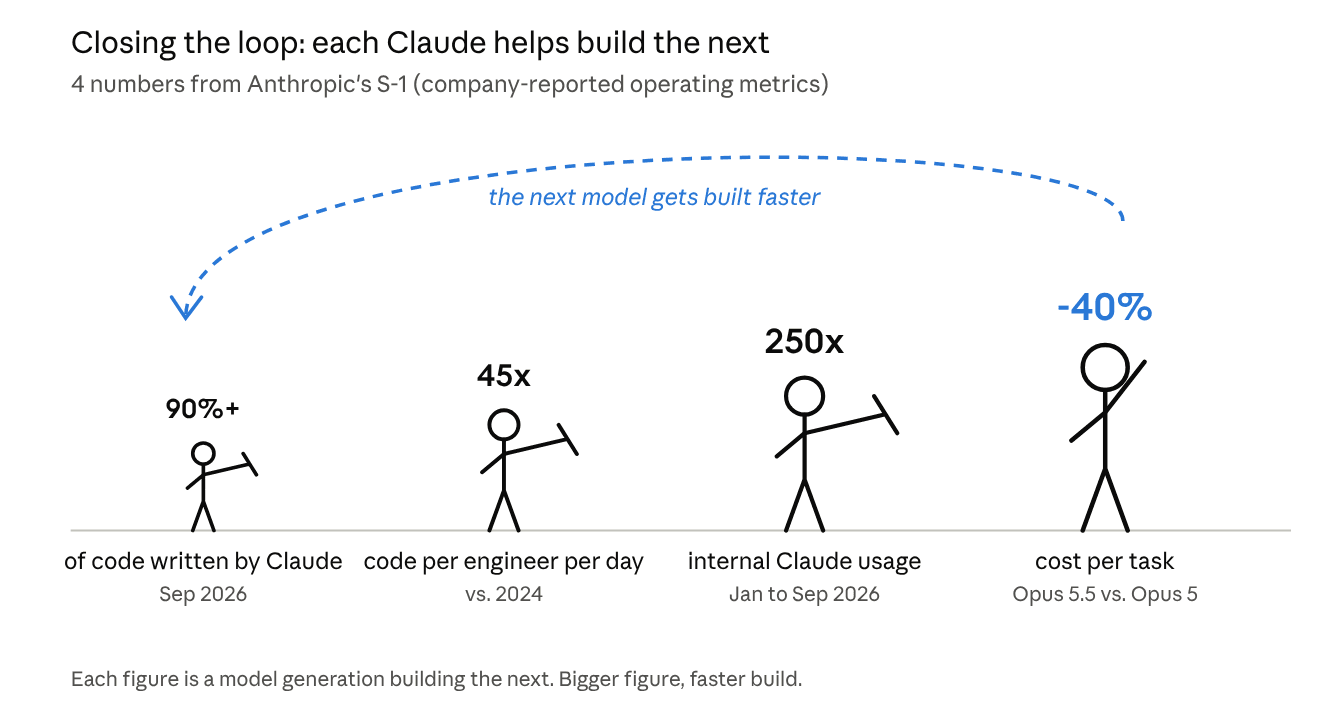
Eleven years later, Anthropic's S-1 describes the same dynamic as an operating strategy. The company calls it "closing the loop": "Each version of a Claude model assists in building the next." Then it puts numbers on it.
- Over 90% of contributions to Anthropic's codebase in September 2026 were written by Claude.
- Code contributed per engineer per day in Q3 2026 was more than 45 times the 2024 average.
- The value of Anthropic's internal Claude usage, at list prices, grew more than 250 times from January to September 2026. In April it passed the company's monthly payroll, excluding stock compensation.
- Claude Opus 5.5 cut customers' cost per task by about 40% versus the prior model, with margins intact.
- Q2 revenue grew 1,368% year over year. Compute spend grew 300%.
The S-1 even lists the endgame as a risk factor: AI that could "substantially automate AI research and development." It uses the phrase "recursive self-improvement" by name. Tim Urban's intelligence explosion is now a disclosed risk in an SEC filing. Wait, what?
Every bubble model I've seen assumes costs and capabilities improve on a fixed schedule. A closing loop means the rate of improvement accelerates. If each model generation cuts the cost of a task by 40%, and generations arrive faster each time, then today's capex math is describing a world that won't exist by the time the bills come due.
It also means leads compound. If your model speeds up building your next model, a head start isn't a fixed distance. It's a faster growth rate. The roughly $800 billion of compute commitments stop looking like a reckless bet and start looking like fuel for the loop, bought ahead of time.
Two honest caveats. First, everyone at the frontier is trying to close this loop, including Google DeepMind, OpenAI and xAI, and fast followers can narrow gaps cheaply through open source and distillation. Second, the 90%, 45x and 250x figures are company-reported operating metrics, not audited financials. The audited numbers in the Wave Test are what make me take them seriously.
Is it really the biggest wave ever?
"Biggest ever" is a strong claim, so let's earn it. There are two ways to measure a wave: how big the build-out is, and how fast the money comes back.
By size, it's close but not yet the record. Measured as a share of GDP, the AI data-center build-out is already one of the two biggest infrastructure booms in American history.
- Housing (2005): 6.6% of US GDP
- Railroads (late 1800s): ~5–6% of US GDP (patchy 19th-century data)
- Tech equipment and software (2000): 4.6% of US GDP
- AI data centers (2027–29, consensus): ~3% of US GDP a year, up from 1.4% in 2025
- Telecom and fiber (2000): 1.2% of US GDP
Sources: Apollo, Torsten Slok; Bloomberg's Justin Fox via Advisor Perspectives; Noahpinion. Broader estimates that count chips, fabs and energy put AI well above 3%, with one above 6%.
By speed, nothing comes close. Apollo's chief economist calculates the AI build-out is adding about 0.85 points of GDP a year. The housing boom at its fastest added about 0.5. Telecom added about 0.15. AI is building at close to twice the pace of the housing bubble.
Now, if I stopped there, the bears would have me. Fast and big is exactly what the housing bubble looked like. What housing never had was this:
- Google went from about $400 million to $6 billion of revenue between 2002 and 2005. Axios noted in April that Anthropic covered nearly four times that ground in a single quarter.
- Snowflake took about a decade to reach $1 billion of revenue. Anthropic got there in about three years. Its latest quarter annualizes to $46 billion.
- Jason Calacanis's This Week in Startups team estimated cumulative revenue in the first seven years after launch: the iPhone, the most successful product in history, did $260 billion. Their projection for Anthropic is $641 billion. It's an estimate, and years four through seven are forecasts. Through year three, Anthropic actually trailed the iPhone, with $5 billion of actual revenue. The projected crossover is year four. That's 2026, and the first half alone brought in $16.3 billion.
More precisely, the AI build-out isn't the largest in history by size. It's the fastest. And it's the first one where revenue is arriving during the build, not a decade after it. Railroads, fiber and housing were all built first and paid for later. This one is being paid for as it's poured.
The bear case, at full strength
I'd be a fraud if I only showed you the slides that agree with me. Social Capital put up some scary ones too, and they deserve a straight answer.
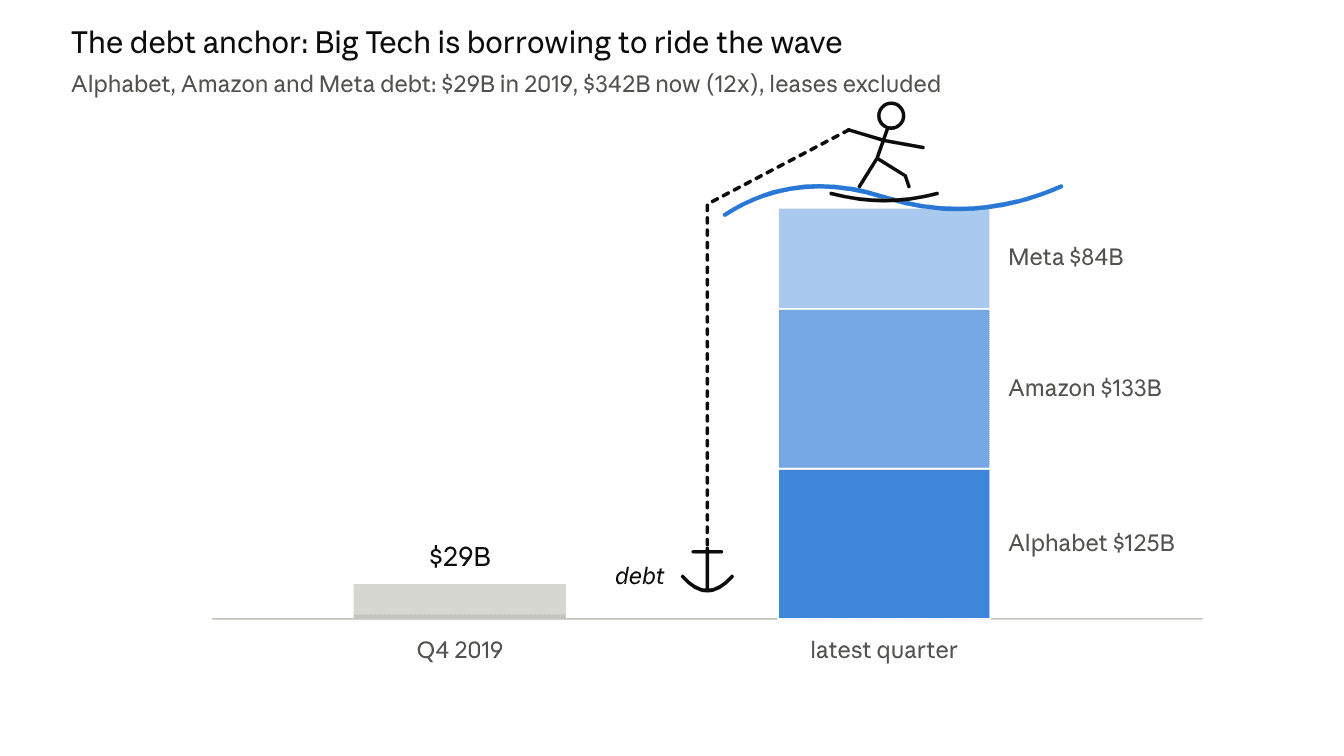
- The debt is real, and it's new. In 2019, Alphabet, Amazon and Meta together owed $29 billion. Today they owe $342 billion. That's a 12x increase, leases excluded. Debt-financed investment chasing future cash flows is the textbook Minsky setup.
- Meta is running on borrowed money. Meta holds $82 billion of cash and securities, almost exactly offset by $81 billion of debt. Its Q3 2026 capex of $34.9 billion beat its $32.8 billion of operating cash flow, so free cash flow was negative $2.1 billion. Social Capital's slide showed Meta's net cash below zero. The honest version is "roughly zero," but the direction is the point.
- Anthropic's commitments dwarf its cash. Roughly $800 billion of compute commitments against $131.7 billion of cash and short-term investments. That's about 6x.
- The money is circular. Amazon and Google are Anthropic's investors, its compute suppliers and its sales channels all at once. Nvidia is even helping finance its own customers. More on that below.
- History rhymes. Perez's own research says installation frenzies usually end in a crash, even when the technology is real. The railroads were real. So was the 1873 panic.
- Some numbers are softer than they look. Social Capital's "customers get 2–10x what they pay" figure is labeled an assumption. And Anthropic's $80.7 billion first-half net loss is real accounting, even though $72.4 billion of it is a mark-to-market on convertible notes, not cash out the door.
Hypothesis: Nvidia is the new Lucent
This is the scariest version of the bear case, so let's state it as a hypothesis and test it.
True fact: I was a fan of Lucent and lost a lot of money on its stock. Oops. Lesson learned.
The hypothesis: Nvidia is propping up demand for its own chips by financing its buyers, just as telecom equipment makers did in 1999.
The evidence for it is real. Nvidia committed more than $40 billion to AI equity investments in the first four months of 2026, including $30 billion in OpenAI and stakes in CoreWeave, Nebius and Lambda. These are all companies that buy Nvidia chips. In August it lined up a $500 billion financing coalition with Apollo, Blackstone, BlackRock, Brookfield, Goldman Sachs and KKR to fund GPU purchases for its customers, with the GPUs themselves as collateral. That rhymes with the dot-com era. Lucent committed $8.1 billion of vendor financing to telecom startups, its revenue fell 69% from 1999 to 2002, and dozens of its borrowers went bankrupt.
But there are good reasons it's only a hypothesis.
- The borrowers are different. Lucent lent to leveraged startups with no revenue. Nvidia's biggest buyers are Microsoft, Alphabet, Amazon and Meta, plus AI labs like Anthropic with $46 billion of annualized revenue.
- The money is mostly someone else's. Jensen Huang says the $500 billion is third-party capital, with Nvidia supporting up to 25% of a given deal.
- There's real end demand. Lucent's customers were building networks for traffic that hadn't arrived. Today's chips are rented out to customers paying billions a month.
- Nvidia can absorb a miss. It has over $50 billion a year of operating cash flow and an Aa3 credit rating. As Tom Tunguz put it, unlike the telecom bubble, "this merry-go-round has paying riders."
My read: the shape matches 1999, but what's underneath doesn't. If AI revenue growth stalls, this is the first place the cracks will show. Until then, it's a hypothesis to watch, not a verdict.
As Noah Smith put it in October, an AI bust isn't obviously imminent. But with hyperscalers now borrowing to build, any slowdown in AI revenue growth could cause a blowup.
I don't disagree with any of that. I disagree with the conclusion people draw from it.
A wipeout is not the same as no wave
I love the nuance that two things can be true at one time. Here's a good example of this.
The risk sits in the leverage layer: hyperscalers and neoclouds whose debt comes due before the revenue does. Some of them will get crushed. Surfers who paddle out too far on too much borrowed money always do.
The strength sits in the demand layer: customers paying, margins rising, productivity showing up in the financials. That layer is getting stronger every quarter.
Railway shareholders were wiped out in 1847. The trains kept running. Pets.com died in 2000. The internet didn't. The difference this time is that the cash flows already exist. In 1999 you had to believe in the revenue. In 2026 you can read it in an S-1.
The question for an investor isn't "bubble or not." It's which layer are you exposed to, and how much leverage sits between you and the customer?
What would prove me wrong
A thesis you can't falsify is a sermon. Here's what I'm watching:
- Net revenue retention falls hard. About 900% won't last. But a collapse toward 120% within a year would mean the expansion story is over.
- Compute's share of revenue climbs again. It fell from 251% to 48%. If it turns back up, the economics aren't scaling.
- Fortune 500 spend stalls. Today it's under 0.1% of their expenses. If it's stuck below 1% in two years, the wave was smaller than it looked.
- Price per task falls faster than usage grows. A 40% cost cut per generation is great until it stops driving more volume.
- Debt maturities outrun cash flow. Watch Meta's free cash flow and the hyperscalers' bond calendars.
- Anthropic's Q3 number. The S-1 leaves it blank. Everything in it points to another huge quarter. If it isn't, I'll write the follow-up.
The illusion that pops
Tim Urban's stick figure stood on the curve, looked back, and saw a flat line. That's the bubble crowd right now. They're staring at the debt, the hype and the valuations, and missing the water underneath.
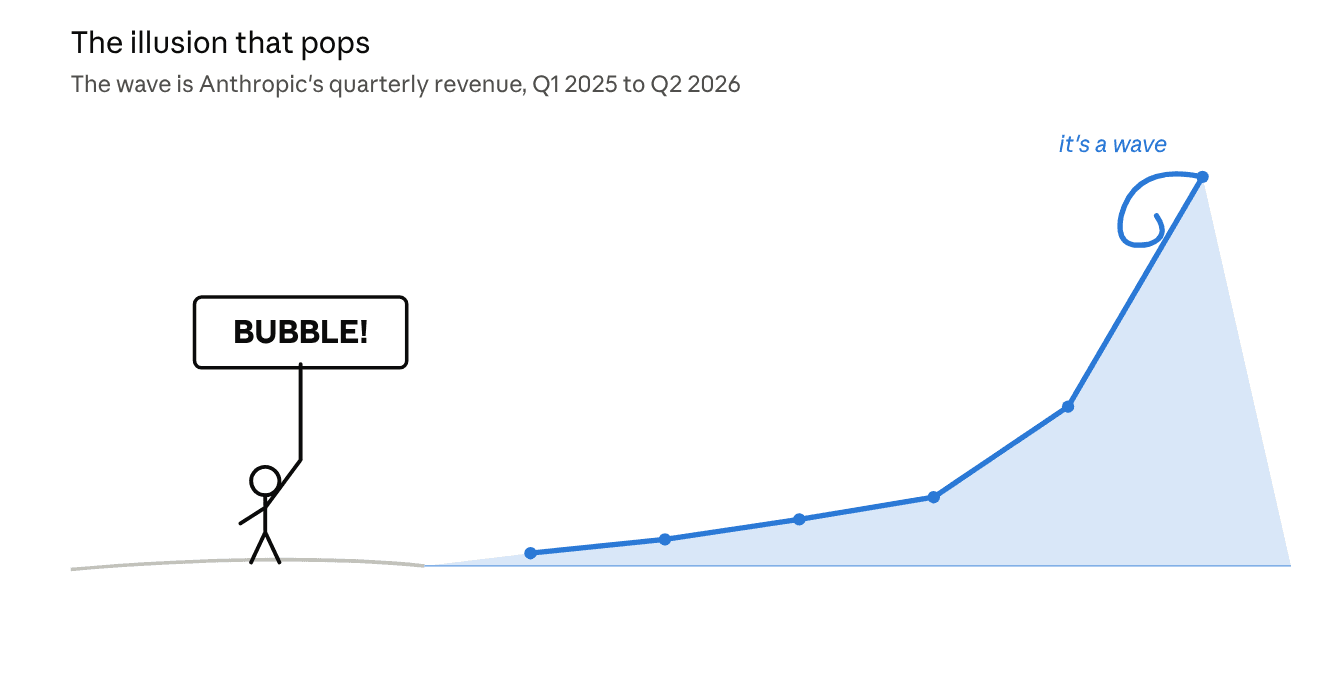
Bubbles pop. Waves break — and when they do, they move the shoreline.
The illusion that's about to get popped is the one that called this a bubble.
Sources and credits
Charts and slide analysis credit: Social Capital, as presented on All-In with Chamath, Jason, Sacks & Friedberg, "Anthropic S-1 Shocker, Greatest Business Ever? Google's $500B Wipeout, Midterm Predictions" (Oct 30, 2026). iPhone vs. Anthropic cumulative revenue chart: This Week in Startups.
- Anthropic, PBC Form S-1 (filed Oct 26, 2026)
- Space Exploration Technologies Corp. Form S-1 (filed May 20, 2026)
- Meta Q3 2026 earnings release
- Alphabet Q3 2026 earnings release
- Microsoft Q1 FY27 earnings release
- Netflix Q3 2026 shareholder letter
- Nvidia FY2026 10-K
- Tim Urban, "The AI Revolution: The Road to Superintelligence" (Wait But Why, January 2015)
- Torsten Slok, "The AI Capex Boom Is Building Twice as Fast as the Housing Boom" (Apollo, Aug 2026)
- Justin Fox, "AI Spending Boom: Massive, Not Unprecedented" (Bloomberg via Advisor Perspectives)
- Noah Smith, "AI vs. the railroads" (Noahpinion, Oct 2026)
- Axios, "Anthropic's unprecedented growth" (Apr 2026)
Revenue per employee: trailing figures use the last four reported quarters; forward figures annualize each company's latest reported quarter. Headcounts are each company's latest reported figure.
Share this article
Loading discussion...
Comments
No comments yet. Start the discussion.