
November 7, 2026 · Mark Rose · 8 min read
The Other Blue Wave
Follow-up to It's Not a Bubble. It's a Wave.
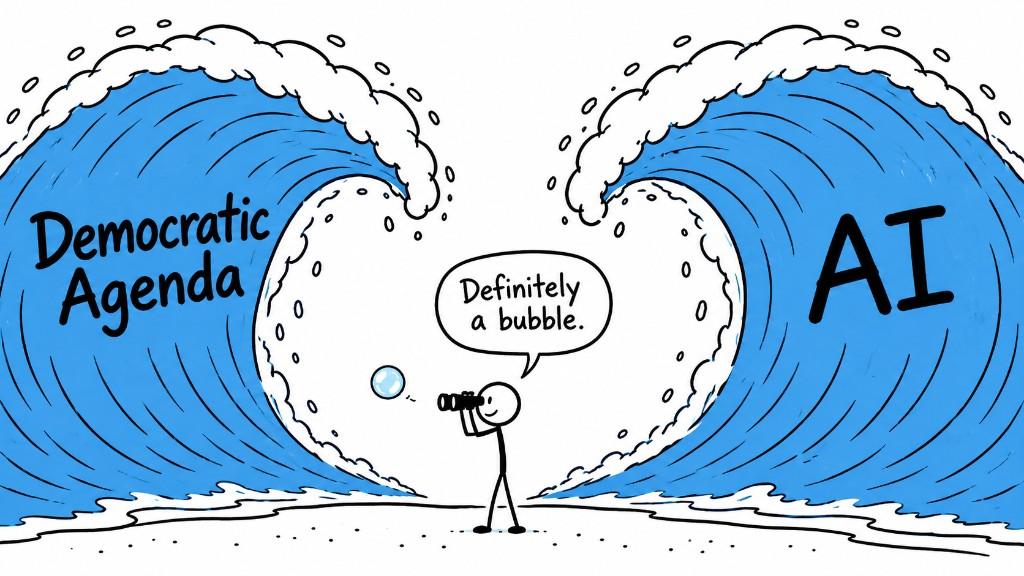
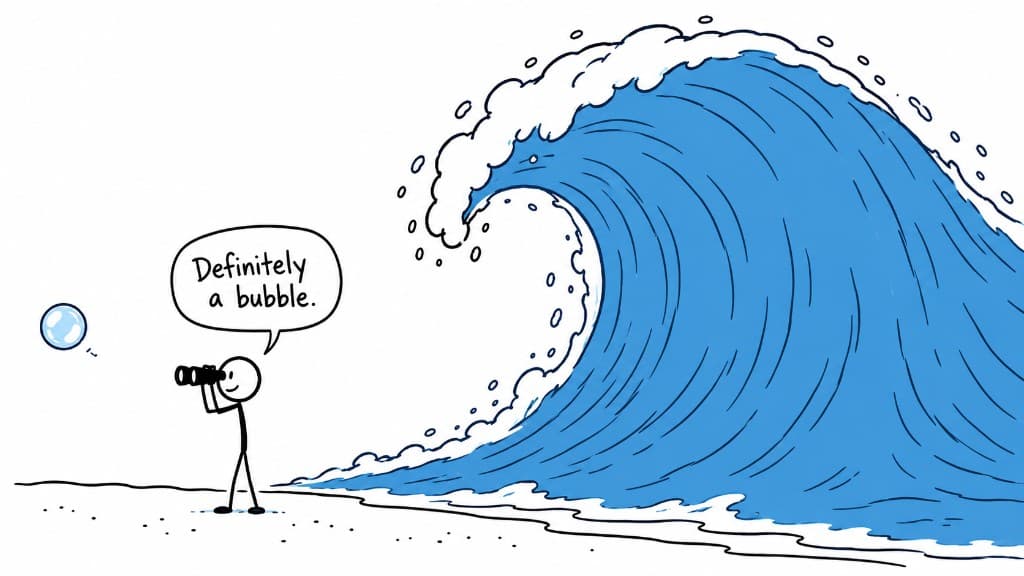
Last week I wrote a blog post on the debate, is AI a bubble? I drew a stick figure on a beach, squinting through binoculars at one tiny soap bubble and announcing, "Definitely a bubble." Behind him rose a giant blue wave. I was very pleased with my writing and my Tim Urban-style illustration.
Then on Tuesday, a second blue wave rolled in from the other direction. I missed that one, and it pushes against the first.
By Thursday, the Nasdaq had its worst day in 19 months and slid into a correction. Nvidia fell 9%. AMD fell 17%. I expect a few friends to send my beach drawing back to me.
Did the AI wave break? After a week of watching the market, I don't think so.
The election hurt the supply side of AI, the data centers and the power behind them. It didn't touch demand.
What actually happened
Democrats won massive control of both chambers on November 3. President Trump still holds the veto.
Analysts pointed to affordability, tariffs and the Iran war as big drivers. Data centers were also a real issue, more than most people in tech expected.
- Lesser known fact: There were 41 local ballot measures on data centers, mostly bans, moratoriums or tighter zoning. The anti-data-center side won all but two.
- Seven in ten Americans oppose an AI data center in their own community.
- In South Carolina and Ohio, Democratic Senate challengers ran ads against data centers and beat Republican incumbents.
The frustration crossed party lines. Electricity bills are up, and voters connected them to the server farms going up down the road. Reason's own read is that Trump was nearly alone among national politicians in praising data centers, and that voters punished his party for it.
The market fell hard on Thursday, November 5.*
| Index or stock | Move |
|---|---|
| S&P 500 | −4.4%, worst day since April 2025 |
| Nasdaq | −5.5%, now 11.9% off its high (a correction) |
| Nvidia | −9.3% |
| AMD | −17.3% |
| CoreWeave | −9.8% |
| GE Vernova | −7.5% |
Friday, chips bounced 4.2% and October jobs came in strong (165,000 vs. 65,000 expected).
The biggest drops hit the companies that build AI capacity: chipmakers, the cloud provider CoreWeave and even power-equipment maker GE Vernova.
Wave or bubble, round two
In the first post I split the AI economy into two layers. The demand layer is customers paying, margins rising, and productivity showing up in the financials. The leverage layer is everyone borrowing to build data centers before the revenue arrives. I said the risk sits in the second one.
The election tested that split sooner than I expected.
I also listed six things that would prove me wrong. This is where each one stands:
| What would prove me wrong | Where it stands |
|---|---|
| Net revenue retention collapses | No new data. |
| Compute's share of revenue climbs again | No new data. |
| Fortune 500 spend stalls | Nothing suggests it. |
| Price per task falls faster than usage grows | Nothing suggests it. |
| Debt maturities outrun cash flow | Warning Will Robinson! Slower, pricier construction stretches the time between borrowing and getting paid. |
| Anthropic's Q3 number | Still pending. |
None of the demand-side signals moved. The sell-off was about the cost and speed of building supply.
In the first post I argued that supply was the bottleneck, with buyers waiting for capacity. The election made that bottleneck tighter. That raises the cost of building, but it doesn't reduce what customers want to buy.
The consequences
I see four practical consequences for AI infrastructure.
1. Decisions move to states and local governments. With a Democratic Congress and a Republican president, a sweeping federal AI law looks unlikely in either direction. Lawyers quoted by CIO Dive expect more congressional investigations and more action from state attorneys general. The real decisions sit with zoning boards, utility commissions and water authorities. Texas Governor-elect Gina Hinojosa campaigned on pausing new data centers until developers carry more of the cost. Projects will get slowed down one permit at a time.
2. BYOP and BYOW: bring your own power, bring your own water. UBS warns that nearly one-third of the data center capacity expected for 2028 is now at risk. Land isn't the constraint. Local opposition centers on electricity and water. The acronyms are inspired by my last party. The invitation said BYOB. I'm just changing what you bring.
- BYOP. Build your own generation on site, whether gas, nuclear or solar with batteries, so the local electric bill doesn't move. Solar works best in the desert Southwest. In Nevada, Amazon has lined up about 600 MW of solar with a similar amount of battery storage plus 100 MW of geothermal, according to Power Engineering. Data centers run around the clock and the sun doesn't, so solar needs a lot of land and batteries, or a partner like geothermal or gas for the night. The Department of Energy has already picked federal sites, like Idaho National Laboratory and Oak Ridge, where data centers can sit next to their own power and outside county zoning fights.
- BYOW. Older data centers use evaporative cooling, which literally evaporates the water it takes in. Newer closed-loop designs recirculate the same coolant. Microsoft says its new closed-loop design loses nearly zero water. Fun fact: Texas lawmakers are already talking about banning evaporative cooling next session.
The new data centers won't simply go to red districts. Republican voters oppose a local data center too, by smaller margins (53–55% vs. 73–76% for Democrats, per Change Research). They'll go wherever a builder shows up with BYOP, BYOW and a tax check. One project in De Soto, Kansas is expected to pay the city about $10 million a year, more than its entire budget. The economic pull is mostly tax revenue. A big data center employs only 20 to 150 people.
3. Capacity already built gets more valuable. When new supply gets harder to build, existing supply is worth more. Anthropic's roughly $800 billion of compute commitments looked aggressive last week. With slower permits, a signed contract for capacity is a scarce asset. It only helps if the data center actually gets built.
4. Companies that borrowed to build carry the most risk. Slower construction means debt sits longer before the revenue shows up. In the first post I said that's where the losses would show up, and neoclouds and other heavily borrowed builders are most exposed.
Demand hasn't changed. Customers are still paying, and models are still writing more of the code. Hardly aware of the irony, voters who rejected a data center down the street still used ChatGPT on their iPhone that same day.
Supporters of the build-out argue data centers bring jobs, tax base and an edge over China. Opponents argue local communities shouldn't pay for them through higher power bills, water use and tax breaks. Both arguments are about who pays for new supply.
What I'm watching now
- Anthropic's Q3 number and its IPO. It has reportedly been targeting a November listing. Whether it prices into this tape, and at what valuation, is the cleanest read on whether investors see a supply scare or a demand scare.
- Local permits, not national polls. Track how many announced data centers get delayed or canceled over the next two quarters.
- Innovation in BYOP and BYOW. Watch deals between AI labs and power producers, and new cooling designs that use less water. I like to say that unless you're breaking the laws of physics, everything is possible. Compared with building the AI data centers themselves, bringing their own power and water doesn't look that hard. The bigger cost is time, which leads to…
- Hyperscaler capex guidance. If Big Tech cuts spending plans because demand is soft, I'm wrong. If it cuts because it can't get permits, I'm early.
So, is AI a bubble? A bubble pops when the buyers disappear. This week the buyers stayed put. What changed is the builders' path. They hit a speed bump, and voters started stacking sandbags along the beach in the form of permits, utility rules and limits on water. The wave still comes in. It just comes in slower, in different places, and mostly for the companies that bring their own power and water.
I'm sticking with wave.
Sources
- BNN Bloomberg: A wipeout for AI stocks sends Wall Street reeling (Nov 5, 2026)
- Fox Business: Nasdaq rises as AI and chip stocks recover (Nov 6, 2026)
- Reason: It Was a Data Center Election After All (Nov 4, 2026)
- Newsweek: Data centers were the big loser of the midterms (Nov 4, 2026)
- CIO Dive: Midterms, Democrats and data centers (Nov 4, 2026)
- Anthropic, PBC Form S-1
- ANS: Data centers planned at four DOE sites
- CBS Austin: Technology could cut water usage by data centers (Sep 2026)
- Sustainability Magazine: Zero-water data center cooling
- Change Research: Opposition to data centers has grown sharply (Apr 2026)
- SAN: Why small cities want data centers
- Power Engineering via Pulse: Amazon turns to geothermal, solar and storage in Nevada (May 2026)
* Thursday's moves: BNN Bloomberg. Friday's bounce and the jobs number: Fox Business.
Part one: It's Not a Bubble. It's a Wave.
Share this article
Loading discussion...
Comments
No comments yet. Start the discussion.